

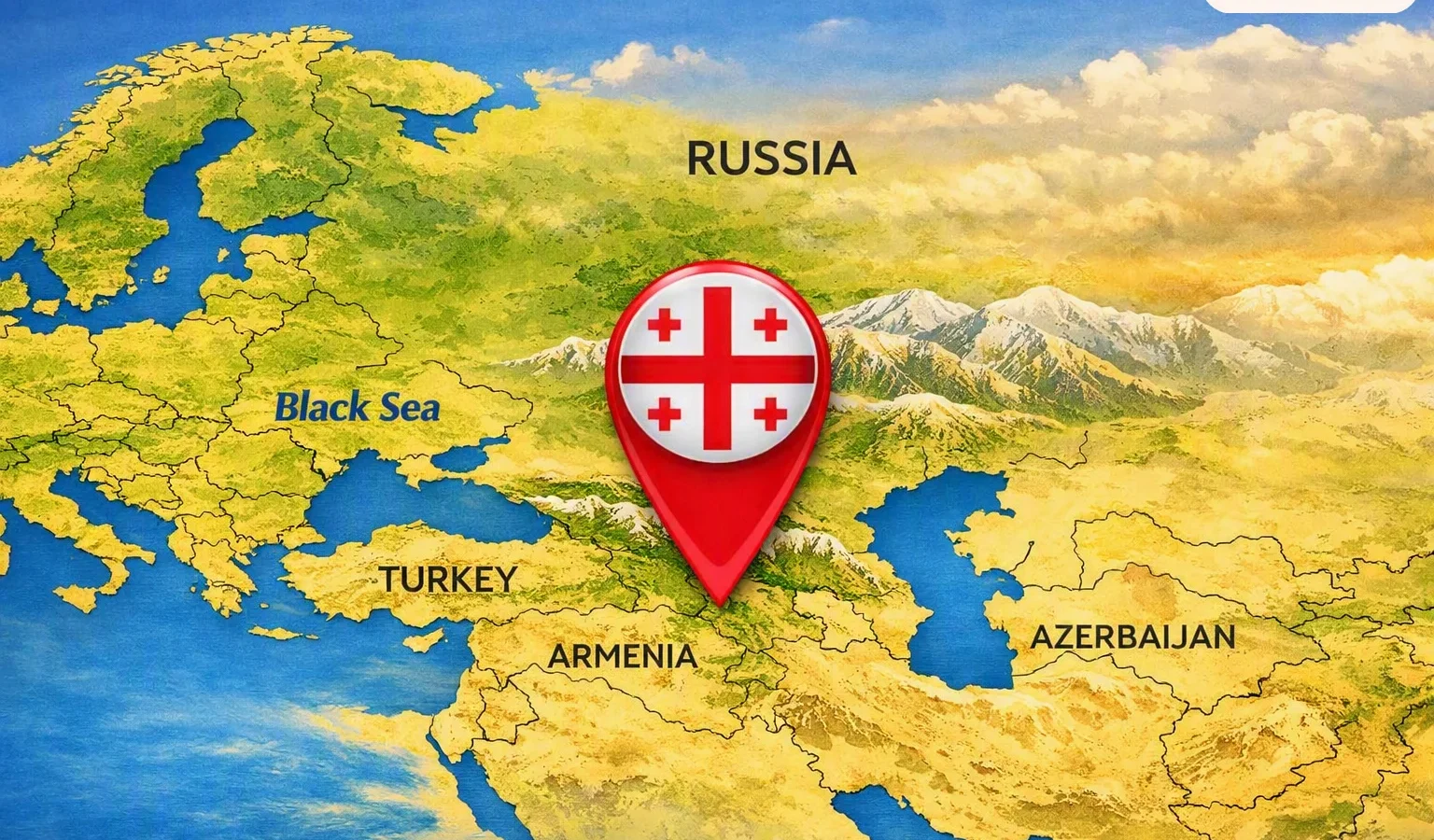
Georgia lets citizens of roughly 94 countries enter and stay for 365 days without a visa — and, unusually, the permission covers residing and working, not just visiting. That single rule is why the country appears on every remote-work list. What those lists mostly get wrong is what happens next: the tax position is narrower than advertised, the banks stopped being easy in 2026, and the politics have been unresolved for two years.
Georgia at a glance
| Capital | Tbilisi (pop. 1,285,300) |
| Currency | Georgian lari (GEL, ₾) — about 2.61 to the US dollar |
| Language | Georgian, its own alphabet and language family. English rated “high” (EF EPI 541, 35th globally) |
| Visa-free stay | 365 days for ~94 nationalities, including the right to reside and work |
| Income tax | 20% flat. 1% turnover under Small Business Status, capped at ₾500,000 |
| Cost, single person | About $670 a month in Tbilisi excluding rent; $594 in Batumi |
| Rent, 1-bed centre | Tbilisi $678 · Batumi $476 |
| Time zone | UTC+4 all year — no daylight saving, so the gap to Europe and the US shifts twice a year |
| Airports | Tbilisi (TBS), Kutaisi (KUT, Wizz Air hub), Batumi (BUS). No direct flights to the United States |
| US advisory | Level 1, normal precautions. Abkhazia and South Ossetia are Level 4, do not travel |
| Foreign residents | 133,857, or 3.4% of the population (2024 census, final) |
The three things most guides get wrong
1. “Foreign income is tax-free”
Half true, and the wrong half is the half that applies to most readers. Georgia taxes on a territorial basis, but source is decided by where the work is performed — not by where the client sits, what currency you invoice in, or which country’s bank receives the money. A remote worker at a desk in Tbilisi billing a US client has Georgian-source income, taxable at 20%.
That is precisely why nearly every serious freelancer here registers for Small Business Status and pays 1% on turnover — not because their income is exempt, but because it is not. The genuinely exempt categories are passive and situated abroad: dividends from foreign companies, interest on foreign accounts, gains on foreign assets, rent from property overseas. And the 1% covers business turnover only; rent, capital gains, interest, dividends and royalties are taxed at 20% regardless.
New in 2026
From 7 March 2026, Small Business Status holders must file a declaration every month, including months with no income. Missing one carries a fine. Guides written before this describe a lighter regime than the one now in force.
2. The digital nomad visa no longer exists
“Remotely from Georgia” is suspended and has been off the government e-visa portal since 2025. The 365-day visa-free rule made it pointless. Any guide still describing its $2,000-a-month income test as a live application route is sending readers to a dead form — and it is the fastest way to tell whether a Georgia guide has been updated this decade.
3. Two immigration facts changed in 2026
- Property residency now costs $150,000, not $100,000. The threshold rose on 1 March 2026. Existing holders may keep renewing on the old basis; new applicants cannot. Every guide still quoting $100k is wrong by half.
- Travel medical insurance became mandatory on 1 January 2026 — minimum ₾30,000 of cover for the whole stay, checked at the border. Residence permit holders are exempt. Almost no English-language guide mentions it, and it is the one new rule that can turn someone around at the airport.
Who Georgia suits
It suits self-employed people whose income is portable and modest enough to sit under the ₾500,000 Small Business ceiling; anyone who wants to try a country for a year without paperwork; and budget-minded people who want European-adjacent living at a third of Western European cost. Tbilisi has fibre, 5G, private hospitals, international schools and an established foreign community.
It suits less well retirees with family in North America — there are no direct flights and the realistic door-to-door from the US East Coast is 14 to 20 hours. It is a poor fit for anyone who needs the state to underwrite their healthcare: the system is about 90% privatised and foreigners are outside the state programme unless they hold a residence permit and meet low-income criteria. Local insurance runs $15–25 a month, international plans $200–500.
The risk nobody weights properly
Not crime — Georgia is genuinely safe and holds a US Level 1 advisory, which few countries do. The risk is political, and it is structural rather than immediate.
A “foreign agents” law passed in May 2024 forced 400-plus NGOs and media outlets to register. Protests have run continuously since November 2024 — past their 600th day as of mid-2026 — with more than 3,000 detentions. The European Commission’s November 2025 enlargement report called Georgia a candidate country in name only, citing serious democratic backsliding; accession talks have never opened and the government has suspended its own efforts until 2028.
Day to day this touches foreign residents very little. Demonstrations are geographically contained, mostly to Rustaveli Avenue and Parliament, and are not directed at foreigners. Two practical points: the UK FCDO warns that foreigners who attend protests risk questioning or refusal of re-entry, and the medium-term concern is that the visa-free, low-tax settlement which makes Georgia attractive is itself a policy choice by a government under pressure. The 2026 changes — a 50% higher property threshold, a new insurance mandate, stricter banking, monthly tax filings — are all consistent with slow closing rather than opening.
Separately, Abkhazia and South Ossetia are occupied by Russia and carry Level 4 “do not travel” status. The administrative boundary lines move: Russian forces periodically shift fencing deeper into Georgian-controlled territory, and people have been detained for crossing a line that was not there the week before. Stay well clear of both.
Where expats actually go
Three cities carry essentially all of it. Tbilisi is the only place with the full stack — hospitals, schools, banks, the Revenue Service, long-haul connections — and its weakness is air quality, which runs about 3.4 times the WHO guideline. Batumi is the Black Sea alternative: rent about 30% cheaper, winters that never freeze, and 2,435 mm of rain a year across 140 rainy days, which is roughly four times London. It is a subtropical rainforest coast that happens to have a beach, and it empties out of season. Kutaisi is the value option, and the reason is the airport — a Wizz Air focus city with two dozen European routes, which is why Georgia is cheap to reach from Europe.
Frequently asked questions
Can I really live in Georgia for a year without a visa?
Yes, if you hold one of roughly 94 qualifying passports, including US, UK, EU, Canadian and Australian. The permission runs 365 days from entry and covers residing, working and studying — wording the US State Department uses explicitly. Overstaying is penalised by fine. Since 1 January 2026 you also need travel medical insurance of at least ₾30,000 for the length of your stay.
Do I pay Georgian tax on money I earn from clients abroad?
If you do the work while physically in Georgia, yes — that is Georgian-source income at 20%, whatever the client’s country or the currency. Registering as an individual entrepreneur with Small Business Status brings it to 1% of turnover up to ₾500,000 a year. Genuinely foreign-source income, such as dividends from a foreign company or rent on property abroad, is not taxed.
Is Georgia still an easy place to open a bank account?
No. Georgian banks tightened through 2025 and 2026 to meet FATF standards, and the walk-in, passport-only account is gone. Bank of Georgia and TBC, which hold about three quarters of banking assets, now want proof of source of funds, a stated purpose for the account and a Georgian SIM card. Citizens of sanctioned states are refused outright, and all non-residents face extra scrutiny. Holding a residence permit or a registered Georgian entity materially improves the odds. Georgia also reports under CRS and has done since 2023.
How bad is the air in Tbilisi?
Bad enough to matter if you have asthma or small children. National levels run about 3.4 times the WHO guideline and Tbilisi has been ranked among the worst capitals in Europe. It is worst in winter and in the valley floor; the higher districts are better. It is the single strongest argument for Batumi, which trades the air problem for a rain problem.
Sources
- Government of Georgia Ordinance No. 255 — visa-free country list, last amended 24 February 2026
- US Department of State — Georgia country information and travel advisory, Level 1, reaffirmed 10 March 2026
- UK FCDO — Georgia travel advice, updated 27 July 2026
- PwC Worldwide Tax Summaries — Georgia, reviewed 2 September 2026
- Georgian Revenue Service Order No. 999, 7 March 2026 — monthly declaration requirement for Small Business Status
- Geostat — 2024 Population Census, final results published 22 June 2026
- European Commission — 2025 Enlargement Report on Georgia, 4 November 2025
- Climates to Travel — Tbilisi and Batumi, 1991–2020 normals
- Numbeo — Tbilisi and Batumi cost of living, retrieved late August 2026 (crowdsourced; treat as order of magnitude)
- EF English Proficiency Index 2025
What is it really like in Georgia?
We are asking residents, and publishing what they say. 0 of the 15 answers we need before we publish any numbers for this place. Four minutes, and the written answers are the part we read closely.
Would you write more than a survey answer? Tell us what you would write.
Follow Georgia
Rules change, prices move, and we reverify these pages. Get an email when something material changes here.

