

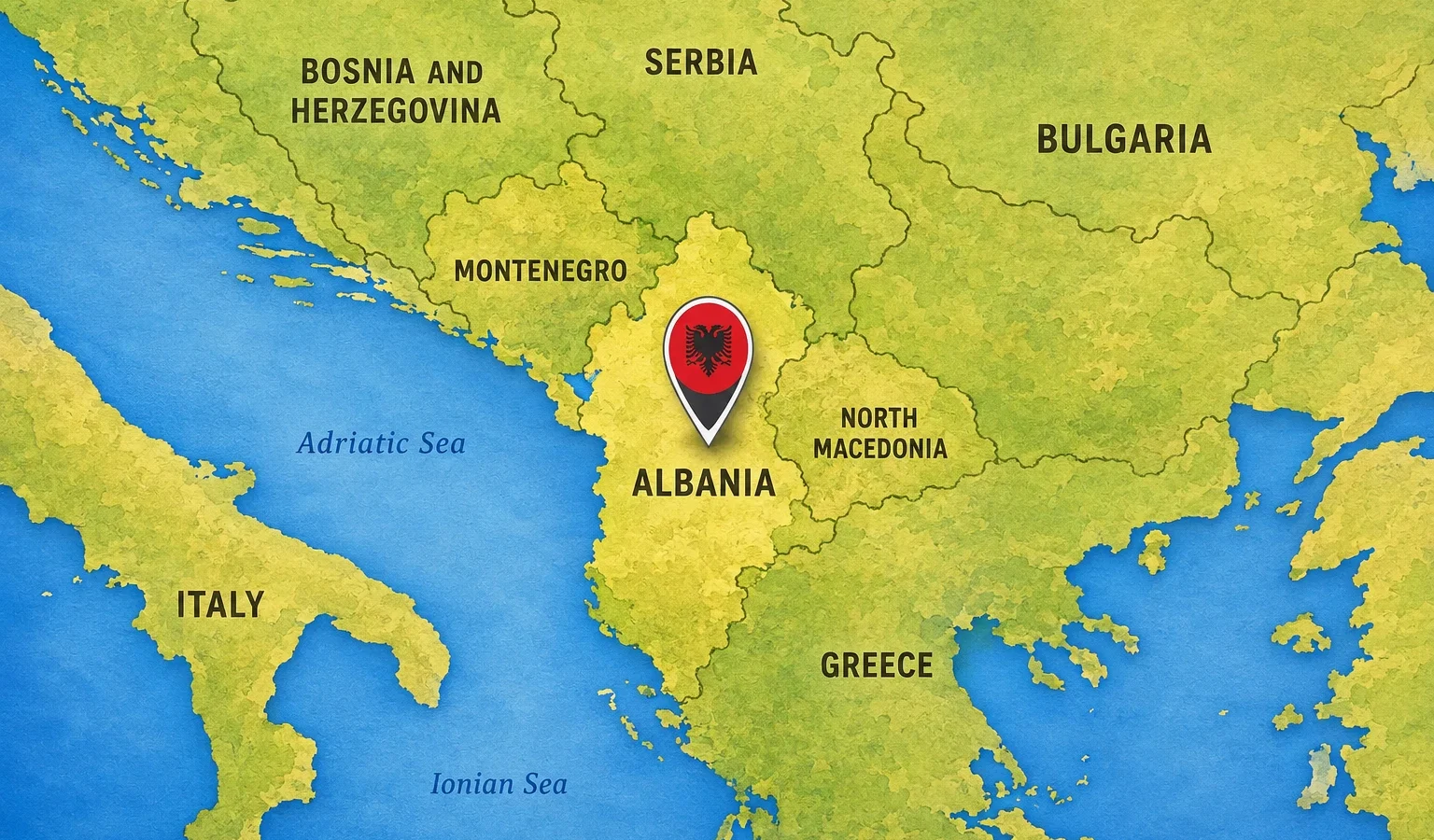
Albania gives US citizens a year in the country without a visa, has the lowest living costs in Europe, and is opening EU accession chapters on a real timetable. It also has a tax system that reversed itself in court, a coastal property market that has doubled in five years, and road deaths at roughly twice the EU average. All three are worth knowing before you commit.
Albania at a glance
| Capital | Tirana (pop. 389,323 city, 598,176 municipality) |
| Currency | Albanian lek (ALL) — about 79 to the US dollar, 92 to the euro |
| Language | Albanian. Italian widely understood by older people, English strong among the young |
| Visa-free stay | US citizens: 1 year. UK, EU, Canada, Australia: 90 days in any 180 |
| Cost, single person | About $778 a month in Tirana excluding rent |
| Rent, 1-bed centre | Tirana $855 · Vlorë $561 · Durrës $466 |
| Time zone | UTC+1, UTC+2 in summer — same clock as most of the EU |
| Airport | Tirana (TIA) is the only working international airport. See the note on Vlorë below |
| EU accession | Candidate since 2014, negotiations opened 2022, chapters opening on a live timetable |
The three things most guides get wrong
1. The visa-free year is a stay permission, not a residence permit
US citizens really do get 365 days from entry, and the State Department confirms it. What it does not do is give you the right to work for an Albanian employer, and it does not count toward permanent residence — that requires held residence permits. It also does not stop you becoming tax resident: 183 days does that on its own, visa or no visa. People arrive on the year, stay past the 183rd day, and acquire a tax obligation they never applied for.
2. Foreign income is taxed
Albania taxes residents on worldwide income. It is not a territorial system and it is not a tax haven, whatever the relocation-industry blogs imply. The freelancer position specifically is worth care: the treatment of self-employed professionals changed around 2023–24, was challenged, and moved again through the courts. Anyone planning around it should take current local advice rather than trust a guide, this one included.
3. Vlorë airport does not exist yet
Coastal property around Vlorë has been marketed, and priced, against an international airport that has never flown a scheduled service and has been the subject of a criminal investigation. Agencies quote 22–28% annual appreciation and €2,500–3,500 per square metre on that thesis. Buy on the beach and the town if you like them; do not buy on the airport.
Who Albania suits
It suits Americans above all — no other European country hands US citizens a year on arrival. It suits people who want Mediterranean coast at Balkan prices, and anyone who wants to be inside the EU’s time zone and a two-hour flight from Rome while paying a third of Italian costs. Tirana has genuinely improved: eleven international schools, English-speaking private hospitals, and a real professional community.
It suits less well anyone who needs serious healthcare. The honest picture is that Albanians with money fly to Italy, Greece or Turkey for anything major, and you should budget to do the same. It suits badly anyone planning to live on the coast year-round without understanding that most of the Riviera closes from November to March — not quietens, closes.
The risk nobody weights properly
Not organised crime, which has a reputation far larger than its relevance to a foreign resident — Albania holds a US Level 1 advisory and street crime is low. The risk is the roads. Albania’s road fatality rate runs at roughly twice the EU average, and it is by a wide margin the most likely way a foreigner comes to harm here. Overtaking on blind bends, unlit pedestrians, and mountain roads without barriers are ordinary conditions. If you take one precaution in this country, it is about driving.
Two structural ones behind it. Water and electricity outside Tirana are less reliable than European visitors expect; rationing and outages are normal in parts of the country and worth asking about specifically before signing a lease. And earthquakes: the 2019 Durrës quake killed 51 people and exposed how much of the coastal building stock was put up without enforcement. Construction standards have tightened since, but a great deal of what is being sold today went up before that.
Where expats actually go
Tirana is the only city that works year-round and holds essentially all of the country’s international infrastructure. Sarandë is the most developed spot on the southern coast, thirty minutes by ferry from Corfu, and the one with the strongest pull for retirees — with the caveat that its permanent population is only 16,400 and it substantially shuts down for the winter. Durrës is the cheapest real option and forty minutes from Tirana, at the cost of crowded beaches and the country’s sharpest earthquake question. Vlorë is the compromise: a genuine city with winter life where the Adriatic meets the Ionian.
One number worth holding on to: Albania’s own population is falling through emigration. A foreigner arriving is moving into a country people are leaving, which is part of why property is cheap, why the labour market is thin, and why the welcome is warmer than in places that feel crowded.
Frequently asked questions
Can Americans really stay in Albania for a year?
Yes. US citizens may remain for up to one year from entry without a visa — the US State Department states it plainly, and it is unique in Europe. Your passport needs at least three months’ validity beyond departure. It permits staying, not working for an Albanian employer, and it does not count toward permanent residence.
What do UK and EU citizens get?
90 days in any 180-day period, the standard Schengen-style allowance. Staying longer means a residence permit. The asymmetry with the American year is real and often missed by guides written for a US audience.
Will I pay Albanian tax?
If you spend 183 days or more in the country in a calendar year, you are tax resident, and Albania taxes residents on worldwide income. That is independent of what visa you hold or do not hold. The rules for freelancers and the self-employed changed recently and were litigated; take current local advice before structuring anything around them.
Is the coast liveable in winter?
Vlorë and Durrës are real cities and keep functioning. Sarandë thins out badly, and the smaller Riviera villages — Ksamil, Himërë, Dhërmi — largely close between November and March, restaurants and all. If you want coast year-round, choose a city that happens to be on the sea rather than a resort that happens to have residents.
Sources
- US Department of State — Albania country information, last updated 26 August 2026
- UK FCDO — Albania travel advice
- Bank of Albania — official exchange rates, retrieved 4 September 2026
- INSTAT — Census of Population and Housing 2023, census date 18 September 2023
- European Commission — Albania accession negotiations, chapter status
- Numbeo — Tirana, Durrës, Vlorë and Sarandë cost of living, retrieved July–August 2026 (crowdsourced; coastal samples are thin, treat as ranges)
- World Health Organization and European Commission road safety statistics
What is it really like in Albania?
We are asking residents, and publishing what they say. 0 of the 15 answers we need before we publish any numbers for this place. Four minutes, and the written answers are the part we read closely.
Would you write more than a survey answer? Tell us what you would write.
Follow Albania
Rules change, prices move, and we reverify these pages. Get an email when something material changes here.

