


Portugal is the most accessible country in Western Europe for someone arriving from outside the EU: safe, well connected, unusually strong in English, and equipped with residence visas that ask you to prove income rather than find an employer. It is also, right now, in the middle of a housing crisis and a hard legal turn on immigration and citizenship. Both halves of that sentence are true at the same time, and most of what is published online was written before the second half happened.
Three changes between 2023 and 2026 invalidate a large share of the advice still circulating. SEF, the immigration agency, was dissolved and replaced by AIMA. The golden visa property route was abolished, so buying a house in Portugal now confers no residence rights whatsoever. And the NHR tax regime, the thing that made Portugal famous among retirees, was closed and replaced by a much narrower scheme that does not cover pension income at all. If a guide mentions SEF appointments, a property-based golden visa, or a ten percent pension rate, it predates the current law.
Portugal at a glance
| Currency | Euro (EUR) |
| Official language | Portuguese. European Portuguese, which differs from the Brazilian variety most apps teach. |
| Population | 11.42 million (INE, 31 December 2025). Foreign residents 1.6 million, about 14 percent. |
| Time zone | UTC+0 in winter, UTC+1 in summer, mainland. Azores one hour behind. |
| Tourist entry | Visa-free Schengen short stay for US, Canadian, UK and most Western nationals: 90 days in any rolling 180-day period, across the whole Schengen area rather than Portugal alone. |
| Main residence routes | D7 passive income, D8 digital nomad, D2 entrepreneur, D3 highly qualified. All are applied for at a consulate abroad, then converted at AIMA in Portugal. |
| Minimum wage 2026 | 920 euros per month, paid over 14 months. Most visa income thresholds are multiples of this figure. |
| Healthcare | SNS, tax-funded and near-universal on the mainland. User fees were abolished in 2022 for almost everything. Access to a family doctor is the weak point, badly so around Lisbon. |
| Citizenship | Seven years of legal residence for EU and Portuguese-speaking-country nationals, ten years for everyone else, under the law in force since 19 May 2026. |
| Safety | Seventh of 163 countries on the Global Peace Index 2026. US State Department advisory at its lowest tier. |
| English | Sixth in the world on the EF proficiency index. Works well in daily life, poorly at government counters. |
| Emergency number | 112. Health triage line 808 24 24 24. |
The three things most guides get wrong
Buying property does not get you residency. The Mais Habitacao package of October 2023 removed every real-estate route from the golden visa, including property-backed funds. Agents still market Portuguese property on a residency premise; it is simply false. What remains are investment fund units at 500,000 euros, research funding, cultural and artistic support from 200,000 euros, and job creation. Property purchase confers no immigration status and does not make you a tax resident either.
NHR is gone, and its replacement excludes pensions. The non-habitual resident regime was abolished for new applicants with effect from 1 January 2024. Its successor, IFICI, gives a flat 20 percent rate on Portuguese income from qualifying scientific, technical, export and start-up activity, and exempts most foreign income. But foreign pensions are explicitly not exempt and are taxed at ordinary progressive rates, which reach 53 percent at the top. The retiree living on a foreign pension, the archetypal Portugal expat of the last decade, now has no special regime at all. This is the single largest change in the economics of retiring here and is still widely misreported.
The citizenship clock got longer, and it starts later than you think. Under Lei Organica 1/2026, in force since 19 May 2026, naturalisation requires seven years of legal residence for EU and CPLP nationals and ten for everyone else, up from a uniform five. The clock runs from the date your first residence permit was issued, not from the day you arrived and not from the day you applied. Applications filed on or before 18 May 2026 proceed under the old five-year rule. Whether residence accrued before that date counts toward the new clock, for people who had not yet filed, is unresolved and in litigation.
Who Portugal actually suits
Portugal rewards people with foreign income who want European infrastructure, mild weather and genuine physical safety, and who are prepared to be patient with administration. It works particularly well for remote workers: fiber reaches roughly 82 percent of homes including much of the interior, gigabit connections are cheap, and the D8 visa is designed for exactly this. It works well for families who intend to stay, because state education is free and public university tuition for residents runs a few hundred euros a year rather than tens of thousands.
It suits people badly in two specific cases. If your plan depended on the old NHR pension rate, redo the arithmetic before you commit; the tax case for Portugal over Spain, Greece or Italy has narrowed sharply. And if you need reliable, quick access to routine primary care, understand that 1.56 million people in Portugal had no assigned family doctor at the end of 2025, that roughly 70 percent of them are in the Lisbon region, and that most foreign residents who can afford it carry private insurance alongside the public system rather than instead of it.
The other thing worth knowing before you arrive is that the housing crisis is a live political issue and expats are part of the local argument about it. Median transaction prices rose 17.6 percent across 2025, Lisbon municipality reached 4,875 euros per square meter, and the minimum wage is 920 euros a month. Rents did finally start falling in 2026, but the gap between what a Portuguese salary buys and what a foreign salary buys is enormous and openly discussed. Arriving with some awareness of that goes a long way.
Where expats actually go
Four districts hold 71 percent of Portugal’s foreign residents: Lisboa, Faro, Setubal and Porto. In practice the anglophone map is narrower still, and the three places below cover most of it. They are genuinely different from each other, and choosing between them is mostly a question of what you want an ordinary Tuesday to look like.
- Lisbon — the capital, the jobs, the transatlantic flights and the highest costs. Dense, hilly, internationally connected, and where the housing pressure and the family-doctor shortage are both worst.
- Porto — smaller, cheaper, wetter, and with markedly better public healthcare access. A working city with a serious food and wine culture rather than a capital.
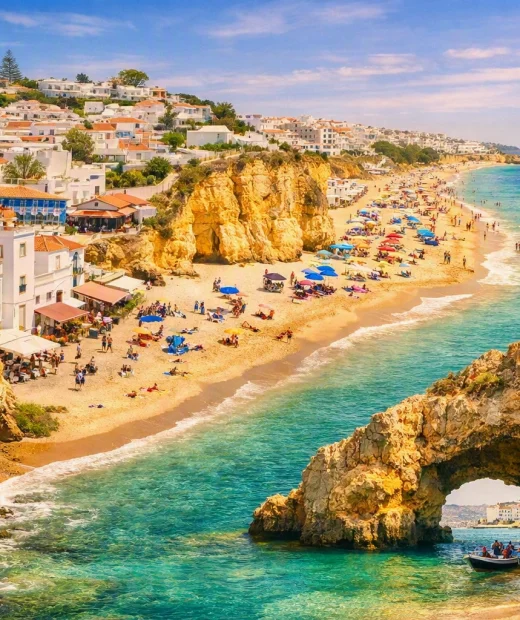
- The Algarve — the retirement and second-home coast, with the best UK flight connections in the country and a real seasonality problem. A car is close to mandatory.
City hubs


National guides
These apply everywhere in Portugal. Where a rule differs locally, the city pages say so.
- Visas and Residency in Portugal — D7, D8, D2, D3, AIMA, permanent residence and the 2026 citizenship rewrite
- Taxes in Portugal — IRS rates, IFICI, treaties, property taxes and what US citizens still owe the IRS
- Healthcare in Portugal — registering with the SNS, what it costs, real waiting times, private insurance
- Cost of Living in Portugal — rents, utilities, groceries and honest monthly budgets
- Housing and Property in Portugal — buying, the CPCV, transaction costs, mortgages, tenancy law and short-term rental rules
- Getting Around Portugal — driving licenses, importing a car, tolls, trains, city transport and airports
- Banking and Money in Portugal — the NIF, opening an account, Multibanco and MB WAY
- Safety in Portugal — the real crime picture, wildfires, earthquakes and emergency numbers
- Schools and Education in Portugal — the state system, international schools and university fees
- Internet and Mobile in Portugal — operators, fiber coverage, prices and the lock-in trap
- Embassies and Consulates in Portugal — where to go and what each one can actually do
Frequently asked questions
Can I get residency in Portugal by buying property?
No. The Mais Habitacao law of October 2023 removed all real-estate routes from the golden visa, including property-backed investment funds. Buying property in Portugal gives you no residence rights of any kind. The remaining golden visa routes are investment fund units of 500,000 euros, research funding, cultural and artistic support from 200,000 euros, company formation with job creation, and direct job creation.
Does the NHR tax regime still exist?
Not for new arrivals. NHR was abolished with effect from 1 January 2024, with a transitional window that has since closed. People already registered keep their status for the remainder of their ten-year run. New residents may apply instead for IFICI, which gives a flat 20 percent rate on qualifying Portuguese employment and self-employment income and exempts most foreign income, but which does not exempt foreign pensions and requires the income to come from specific scientific, technical, export or start-up activity.
How long does it take to get Portuguese citizenship?
Seven years of legal residence for EU and CPLP nationals, ten years for everyone else, including Americans, Canadians and Britons, under Lei Organica 1/2026. The residency clock runs from the date your first residence permit was issued rather than from your arrival. You also need A2 Portuguese, demonstrated through the CIPLE exam or an accredited course, and the 2026 law adds a civic-knowledge component whose format was still being developed in mid-2026.
Do I need to exchange my US, Canadian or UK driving license?
Not immediately, and the widely repeated 90-day rule is wrong. Under Decreto-Lei 46/2022, holders of licenses from OECD and CPLP countries, which includes the United States, Canada and the United Kingdom, may drive in Portugal without exchanging, provided the license was issued or last renewed within 15 years and the holder is under 60. The exemption lapses on your 60th birthday or when the license passes 15 years, at which point exchange becomes compulsory. Jersey, Guernsey and Isle of Man licenses must be exchanged.
Is healthcare free in Portugal?
Largely, for legal residents. Decreto-Lei 37/2022 abolished user fees across almost all SNS services, leaving them essentially only for emergency department attendance without a prior referral. The cost is not the problem; access is. Register at the health center for your address to get a numero de utente, then wait to be assigned a family doctor, which in the Lisbon region may not happen at all.
Can I stay in Portugal for 90 days, leave for a day, and come back?
No. The limit is 90 days in any rolling 180-day period and it applies across the entire Schengen area, not to Portugal individually. Since 10 April 2026 the Entry Exit System records entries and exits biometrically at every external Schengen border, so the old practice of relying on inconsistent passport stamping no longer works.
Sources
- AIMA — Agencia para a Integracao, Migracoes e Asilo, residence permits and the ARI investment routes
- Instituto Nacional de Estatistica — population, house prices and transaction data, 2025 and 2026
- Diario da Republica — Lei Organica 1/2026 (nationality), Lei 61/2025 (family reunification), Decreto-Lei 46/2022 (driving licenses), Decreto-Lei 37/2022 (SNS user fees)
- Autoridade Tributaria e Aduaneira and Portaria 352/2024/1 — IRS rates and the IFICI regime
- Conselho das Financas Publicas — SNS performance report on 2025, published June 2026
- Institute for Economics and Peace — Global Peace Index 2026
- EF Education First — English Proficiency Index, Portugal
What is it really like in Portugal?
We are asking residents, and publishing what they say. 0 of the 15 answers we need before we publish any numbers for this place. Four minutes, and the written answers are the part we read closely.
Would you write more than a survey answer? Tell us what you would write.
Follow Portugal
Rules change, prices move, and we reverify these pages. Get an email when something material changes here.

