

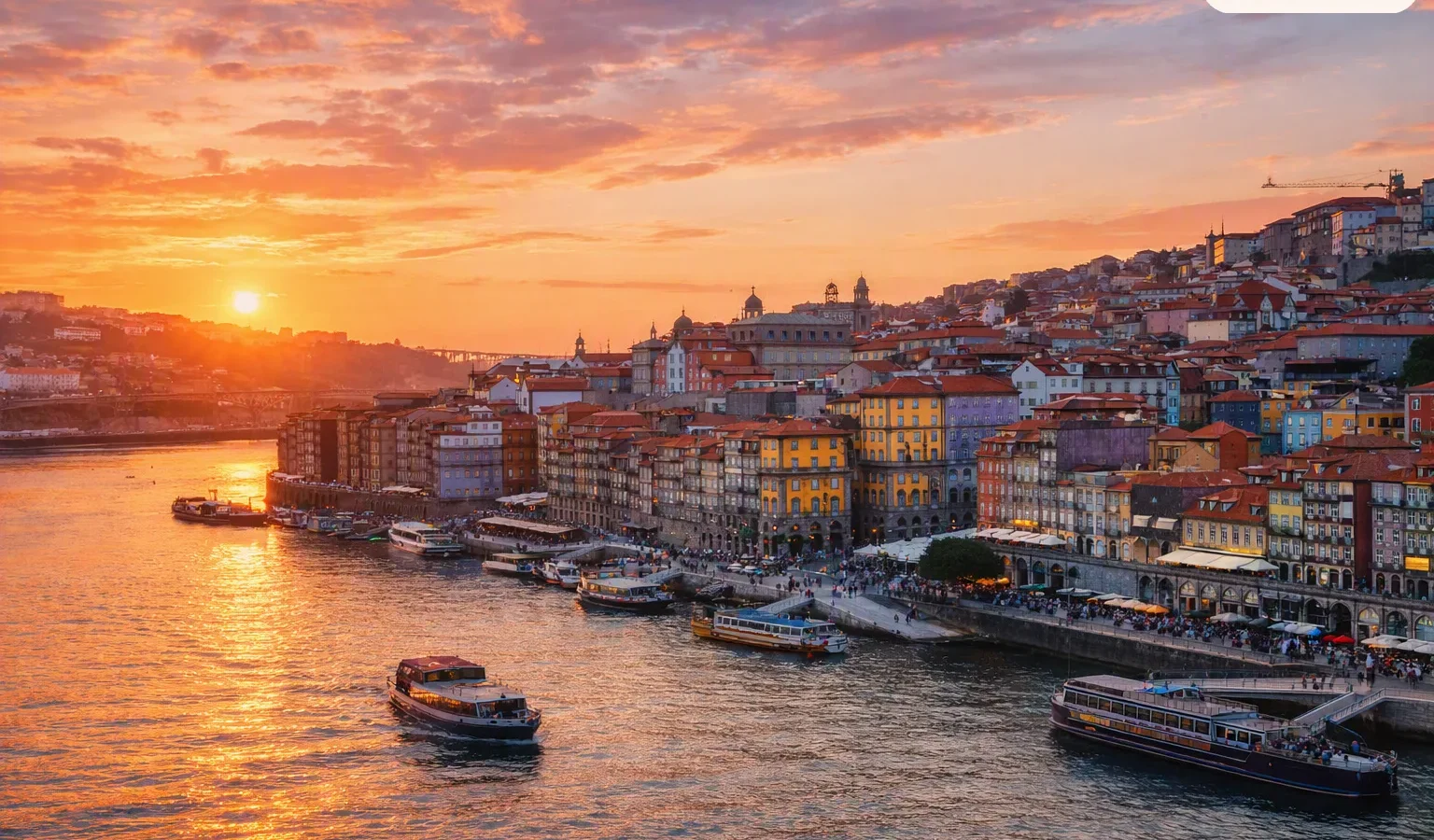
Porto is a granite city of about 240,000 in the municipality and 1.7 million across the metropolitan area, stacked steeply above the Douro where the river meets the Atlantic. It is smaller, darker-stoned, greyer-skied, colder, wetter and considerably more Portuguese than Lisbon. Where Lisbon has been internationalised, Porto has been touristed — and that distinction is the whole thing.
Large numbers of visitors come, mostly to a compact zone: Ribeira, Aliados, Clerigos, the Gaia port lodges. But the international resident population is a fraction of Lisbon’s, and the city outside that core still runs on Portuguese terms. The regional temperament is a real thing rather than folklore — more direct, more sardonic, more working-class in self-image, more attached to its football club, and quietly contemptuous of Lisbon. Meals are heavier. Wine culture is serious. The city goes to bed earlier than Lisbon, except during Sao Joao and during term-time student nights.
Porto at a glance
| Population | About 240,000 in the municipality, 1.7 million across the metropolitan area |
| Foreign residents | 58,161 in the municipality — third-highest in Portugal, but under a third of Lisbon’s 202,430 |
| Median rent, new contracts | 10.13 euros per square meter across the metro area (INE, Q1 2026). Asking rents in the city 16.8, down 2.5 percent year on year |
| Purchase price | 4,060 euros per square meter asking (idealista, Feb 2026, a record). Transacted median across the parishes 3,510 |
| Monthly transport pass | Andante at 30 euros municipal, 40 euros metropolitan. Free under 23 |
| Realistic monthly budget | 1,200–1,500 frugal or 1,800–2,400 mid-range for one person; 2,600–3,200 for a couple |
| Climate | 19.3 C average maximum and 1,147 mm of rain across 105 days. This is the number that decides things |
| Airport | Francisco Sa Carneiro, 11 km out, direct metro to the terminal, 25 minutes to Trindade. 16.9 million passengers in 2025 |
| Family doctor | Fewer than 100,000 people unassigned across the whole North, against 1.17 million in the Lisbon region |
Who Porto suits, and who it does not
It works for people who wanted Lisbon’s qualities at 70 to 80 percent of the price and will accept 1,147 mm of rain a year for it. For people who want a walkable small city with a real river and a real sea fifteen minutes away. For anyone whose social life can run on fewer, closer connections. For food and wine people. And for anyone working remotely or in tech — the Porto tech scene is substantial and growing, anchored by Farfetch and its successors, UPTEC and the Porto Tech Hub network.
It works badly for anyone who needs sun in winter, anyone who dislikes damp, and anyone whose social life needs scale and turnover — Porto’s international community is realistically a few thousand people, most of whom attend the same events, and it can feel repetitive after eighteen months. It also works badly for anyone expecting Lisbon’s flight connectivity or Lisbon’s anglophone job market.
The damp, which is not a minor caveat
Porto takes 1,147 mm of rain across 105 days a year, against Lisbon’s 794 mm across 76. November is the wettest month at 166 mm across thirteen days; January, February and December are 151, 98 and 153. It is not cold — January maxima are 14 C — but it is persistently wet, gray and damp.
Combine that with the national housing stock, in which 24.4 percent of dwellings have a leaking roof, damp walls or rotting window frames, and 47.7 percent of energy certificates are rated D or below, and the practical result is an unheated granite flat at 13 C and 80 percent humidity from November to March, mold on the north-facing bedroom wall, and clothes that never quite dry. Dehumidifiers are standard household equipment here. This is the number-one complaint of people who leave Porto, and the people who leave are almost always the ones who visited in July and moved in October.
Say it the other way round too: May, June and September are Porto’s best months, and September may be the single best month anywhere in Portugal — 23.5 C, fewer than six rain days, and the harvest under way in the Douro.
The healthcare advantage nobody mentions
The North had fewer than 100,000 people without an assigned family doctor in May 2026, against 1,165,496 in Lisboa e Vale do Tejo. A new resident registering at a Porto centro de saude has a materially better chance of actually being assigned a medico de familia than one in Lisbon.
That is arguably the strongest practical argument for Porto over Lisbon, and it is almost never made in expat writing. Add that Hospital de Sao Joao is the second-largest hospital in the country with a strong national reputation in oncology, transplantation and cardiology, that IPO Porto is one of three national cancer centers and genuinely excellent, and that Hospital Pedro Hispano in Matosinhos is frequently cited as one of the better-run integrated units in Portugal. The offset: English-speaking private GPs are in noticeably thinner supply than in Lisbon.
Where to live
Seven areas cover most of it: Foz do Douro where the river meets the ocean and Porto’s old money lives; Cedofeita, the arts district; Bonfim, the best current value and the fastest-changing; Boavista, the modern business spine; Matosinhos, the coastal fishing port on the metro; and Vila Nova de Gaia across the river. Ribeira is on the list only so it can be ruled out — it is almost entirely short-term rental and restaurant use now, permanently crowded, extremely steep and unreachable by car. Full detail, with prices and trade-offs, on the neighborhoods page.
One trend to weigh: Porto’s advantage is eroding in real time. Sale prices in the municipality rose 21.6 percent year on year in Q1 2026, faster than Lisbon’s. Asking rents, by contrast, fell 2.5 percent. Buying is getting harder in Porto faster than renting is.
An ordinary week
Built around the river, the sea and eating. A morning bica; the Bolhao market or a neighborhood mercearia; a nine-euro lunch heavier than Lisbon’s — francesinha, tripas a moda do Porto, bacalhau; a walk along the Douro or the Matosinhos seafront; a beer on an esplanada when it is not raining and indoors when it is, which is often. The riverside walk from Ribeira to Foz is about six kilometers and is one of the best urban walks in Portugal.
The year turns on Sao Joao, 23 and 24 June, and on the ground it is wilder than Lisbon’s Santo Antonio. The whole city is out on the night of the 23rd: grilled sardines and caldo verde on every street, people hitting each other on the head with plastic hammers and garlic flowers, hot-air balloons released over the river, a midnight firework display from the Ponte Luis I, and an all-night walk down to Foz to watch the sunrise and eat at Matosinhos. The 24th is a municipal holiday and nothing works. It is not stage-managed for tourists. More on the calendar and where residents actually go.
The international community
Small, and that cuts both ways. Brazilian first and dominant, then a scattering of French, Italian, Spanish, German and British, a growing North American cohort, Ukrainians, and a substantial transient student population from the university’s Erasmus intake. Cedofeita and Bonfim for the younger and more bohemian; Boavista, Foz and Matosinhos for families and higher earners; Gaia’s riverside for those chasing value. There is no Porto equivalent of Cascais — no single suburb that reads as where the foreigners live.
Making Portuguese friends is genuinely easier here than in Lisbon, and this is one of the few pieces of received expat wisdom that holds up. Porto’s foreign population is small enough that it has not generated a self-sufficient parallel society, so foreigners get pushed into Portuguese contexts by default, and northern directness and hospitality are broadly as advertised. The offset is that the international community is small enough that if you do not get on with the fifty or so people who show up at everything, there is no second cohort behind them.
On language: English works in the tourist economy, in tech and among the under-40s, and less well than in Lisbon in ordinary shops and services. Learning Portuguese is more necessary here — and the northern accent, faster and with a distinctly different treatment of unstressed vowels, is harder than the Lisbon standard most courses teach.
Guides to Porto
- Neighborhoods — Foz, Cedofeita, Bonfim, Boavista, Matosinhos, Gaia, and why not Ribeira
- Housing — renting and buying, the damp problem in practice, and the AL cancellations
- Cost of Living — 2026 figures, and how far the gap with Lisbon has really closed
- Healthcare — Sao Joao, Santo Antonio, IPO, the private groups, and the family doctor advantage
- Getting Around — six metro lines, the works running to 2028, the airport link, and the hills
- Things to Do — markets, beaches, the Douro, the festival calendar, and places a resident would know
Frequently asked questions
Is Porto cheaper than Lisbon?
Yes — roughly 20 to 30 percent below Lisbon on housing and 10 to 15 percent on everything else. A one-bedroom in central Porto runs 900 to 1,300 euros against Lisbon’s 1,300 to 1,700. But the gap is closing: Porto municipality sale prices rose 21.6 percent year on year in Q1 2026, faster than Lisbon’s, while asking rents fell 2.5 percent. Renting still favors Porto clearly; buying less so each year.
How bad is the rain in Porto really?
1,147 mm across 105 days a year, against Lisbon’s 794 mm across 76. November is the worst at 166 mm over thirteen days. It is not cold — January maxima of 14 C — but the combination of persistent damp with uninsulated, unheated granite buildings produces interiors at 13 C and 80 percent humidity, and visible mold. Dehumidifiers are standard equipment. This is the single most common reason people leave.
Can I fly direct from Porto to the United States?
Partly. TAP flies Newark year-round and Boston seasonally; United serves Newark; Air Canada flies Montreal seasonally; Delta launched seasonal New York JFK in May 2026. Northern European connectivity is excellent year-round on Ryanair, easyJet, Wizz, TAP and Vueling. But anyone needing frequent US travel in winter will still route via Lisbon, Madrid or another European hub.
Which Porto neighborhood offers the best value?
Bonfim, consistently. East of the center, working-class in origin, with metro at Campo 24 de Agosto and Heroismo, one-bedrooms at 750 to 950 euros, and asking prices of 3,651 euros per square meter that rose only 2.2 percent year on year — the softest market in the city. The trade-offs are real: patchy street by street, some rough blocks, a lot of unrenovated stock with serious damp, and uphill from the river in both directions.
Is it easier to meet Portuguese people in Porto?
Yes, and this is one of the few pieces of expat received wisdom that holds up. Porto’s foreign population is roughly a quarter of Lisbon’s and has not generated a self-sufficient parallel society, so foreigners end up in Portuguese contexts by default. The cost is that the international community is small — realistically a few thousand people attending the same events — and can feel claustrophobic after a year or two.
Sources
- INE — house price and rent statistics at local level, Q1 2026
- idealista — Porto asking prices by zone, February 2026
- AIMA — Migration and Asylum Report, foreign resident counts by municipality
- Observador — SNS family doctor figures, May 2026, and the Camara do Porto Alojamento Local cancellations, May 2026
- IPMA — climate normals 1991–2020, Porto Pedras Rubras
- STCP and Metro do Porto — 2026 Andante tariff schedule and network expansion program
What is it really like in Porto?
We are asking residents, and publishing what they say. 0 of the 15 answers we need before we publish any numbers for this place. Four minutes, and the written answers are the part we read closely.
Would you write more than a survey answer? Tell us what you would write.
Follow Porto
Rules change, prices move, and we reverify these pages. Get an email when something material changes here.

