

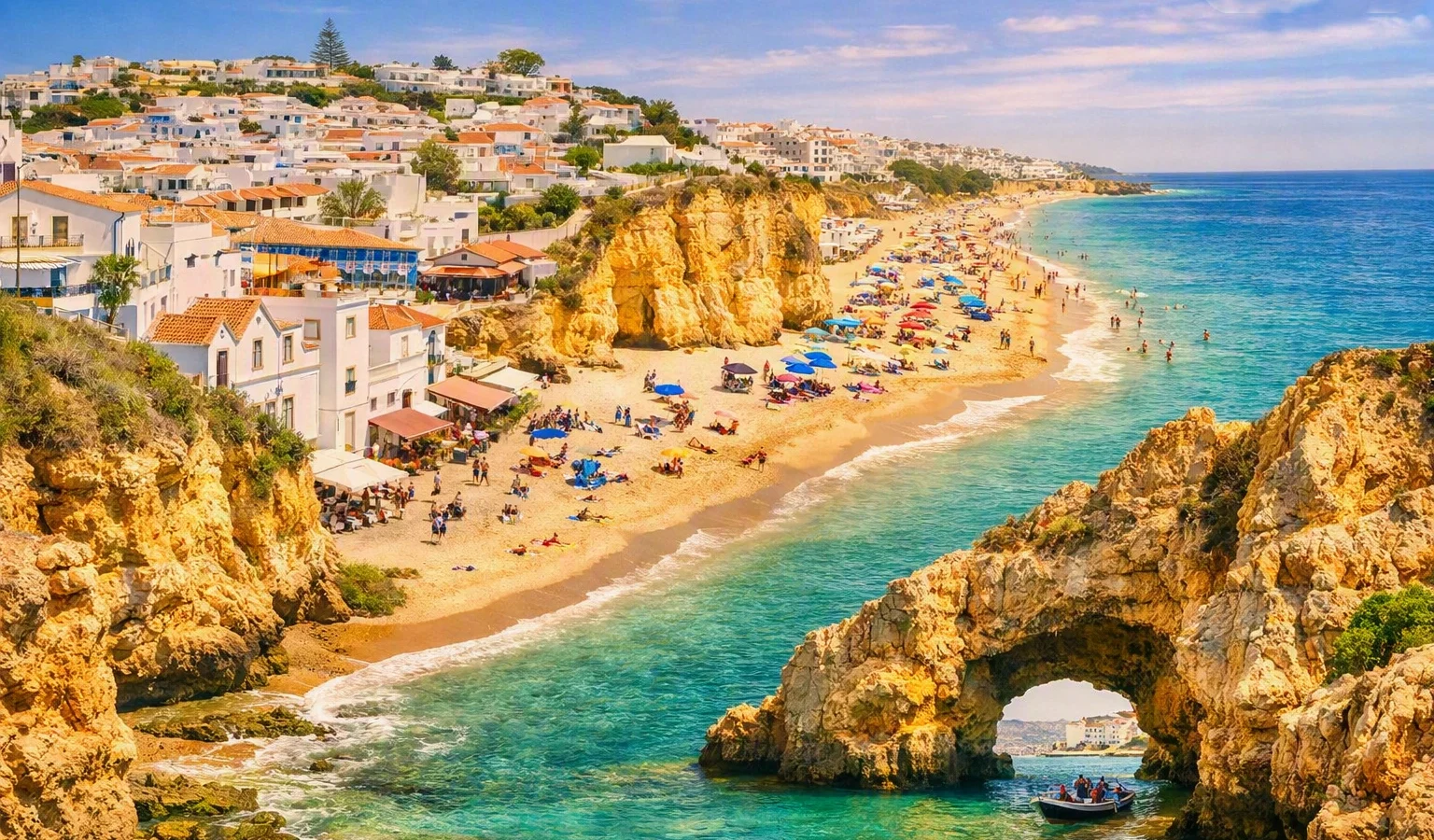
The Algarve is a 155 kilometer coastal strip of about 470,000 permanent residents that hosts over ten million air arrivals a year and something like four to five times its resident population at the August peak. It is the easiest place in Portugal for an English speaker to live, and the hardest one to live in well. Almost everything that goes wrong for people here traces back to a single fact: the Algarve in February and the Algarve in August are not the same place.
It is also not one region. The Barlavento in the west, Lagos to Sagres, is dramatic — ochre cliffs, coves, Atlantic surf, cooler water, wind. The Sotavento in the east, Faro to Vila Real de Santo Antonio, is flat and warmer, lagoon-and-sandbar country behind the Ria Formosa with island beaches reached by ferry. The central strip — Albufeira, Vilamoura, Quarteira — is the mass-tourism engine and looks it. And the serra inland — Monchique, Silves, Sao Bras, Loule’s hinterland — is cork oak, orange groves, empty roads and depopulating villages, a completely different proposition from the coast twenty minutes away.
The seasonality problem, without hedging
In August: the EN125 and the coastal roads are gridlocked. Parking at any beach requires arriving before half past nine. Restaurants require booking. Supermarket queues run twenty deep. Prices rise on everything from a beer to a taxi. And the emergency departments at Faro and Portimao go into escalation — both had documented surge episodes with multi-hour waits in July and August 2026, and Faro again in July 2025.
In February: large parts of Albufeira’s Oura strip, Praia da Rocha, Alvor, Carvoeiro and Vilamoura are physically shut. Restaurants close for two to three months, some from November to March. Bars have no staff. Whole apartment blocks are dark. The beaches are empty and beautiful, the twenty-degree afternoon is real and lovely — and at six in the evening in January there is nowhere open to go and nobody to go with.
The Algarve’s highest-attrition group is couples in their fifties who bought after a good August and then discovered a February. If you take one thing from this page, take that.
The Algarve at a glance
| Population | About 470,000 permanent residents, several times that at peak season |
| Foreign residents | The highest concentration in Portugal. Vila do Bispo is 41.7 percent foreign; Aljezur, Albufeira, Lagos, Loule and Tavira all exceed 30 percent |
| Median rent, new contracts | 10.71 euros per square meter (INE, Q1 2026). Asking rents average 15.5, and are polluted by holiday inventory — see below |
| Purchase price | Region average 4,165 euros per square meter, up 8.3 percent year on year (idealista, July 2026). Loule 5,079; Olhao 3,456 |
| The unavoidable cost | A car. 200–350 euros a month all-in, before anything else |
| Realistic monthly budget | 1,500–2,200 single with a car; 2,200–3,200 a couple |
| Climate | About 3,000 hours of sunshine a year, among the highest in Europe. Sea peaks at 21.5 C in September, not August |
| Airport | Faro, 4 km from the city. 10.4 million passengers in 2025. No transatlantic service and none in prospect |
Who the Algarve suits
It works for retirees with an established social structure — a golf club, a church, bridge, bowls, afpop, a boat. For people with a car and no need to be anywhere on a schedule. For families who have chosen a year-round town and put children into local or international school. For anyone who genuinely wants outdoor life — walking, cycling, golf, sailing, birdwatching — as the organizing principle of their days. And for people who like the off-season and find the summer intolerable, rather than the other way round.
It works badly for anyone under 35 without remote income; anyone who needs professional stimulation, cultural depth or a large peer group; anyone without a car; and anyone who assumes a summer holiday feeling can be made permanent.
Where to live
Five towns cover most decisions, and they are not interchangeable.
- Lagos — the barlavento’s best all-round year-round town and the most common answer to where in the Algarve someone should actually live. Walled historic center that stays open through winter, a marina, a working fishing harbor, Meia Praia for walking, and the cove beaches west of town. A young international layer coexists with an older British, German and Dutch retired population. 4,631 euros per square meter and the slowest growth in the region, which suggests the market has topped out. Over 30 percent foreign.
- Portimao — the region’s most urban option, around 60,000 people with a real high street, a hospital, shopping centers, a cinema and chain retail. Not pretty; much of it is undistinguished 1970s to 90s construction. But for anyone who needs infrastructure — a supermarket at nine at night, a hardware shop, a dentist, a bank branch — it is the practical choice, and at 3,539 euros per square meter it is cheap relative to Lagos and Loule. Praia da Rocha, its beach district, is a separate and much louder proposition.
- Albufeira — the mass-tourism capital, and the starkest seasonality contrast in the region. The Oura strip is an unapologetic package-holiday nightlife district, predominantly British and Irish, extremely loud from May to September and dead from November to March. The old town above the beach is genuinely pretty and largely separate. Long-term foreign residents actually live in the hinterland — Olhos de Agua, Ferreiras, Guia, Vale Carro. Excellent anglophone infrastructure, and correspondingly the easiest place in Portugal to live a decade without learning Portuguese.
- Faro — the regional capital, university town and administrative center, and the one place with a year-round working population not dependent on tourism. Faro’s cafes are open in January because civil servants and students need them. A hospital, the university, the train interchange, the Ria Formosa on the doorstep with ferries to Ilha Deserta, Farol and Culatra. The fastest-rising market in the region at 3,885 euros per square meter, up 17 percent in a year from a low base. No beach of its own — Praia de Faro is on a barrier island nine kilometers out, under the flight path, reached by a single-lane causeway.
- Tavira — the most conventionally beautiful town in the eastern Algarve and the least spoiled. A Roman bridge, a Moorish castle, a river through the center, a covered market, and ferry access to Ilha de Tavira, where the water is warm, calm and shallow in a way the western coves never are. Cheapest of the five at 3,584 euros per square meter, with asking rents down 7.1 percent — the sharpest fall in the region. Quiet, and in winter very quiet. No hospital; Faro is 35 minutes.
Also worth knowing: Loule, Almancil, Quinta do Lago and Vale do Lobo are the money, at 5,079 euros per square meter, and where the international schools and private clinics cluster. Olhao is a working fishing port next to Faro with the best fish market in the region, the cheapest coastal prices at 3,456, and visible gentrification. Silves, Sao Bras de Alportel and Monchique inland are considerably cheaper and the honest answer for anyone whose budget will not reach the coast — and they carry the region’s highest wildfire exposure.
A car is necessary. Not recommended — necessary.
This is the most important practical fact about the region. It is a 155 kilometer linear strip with dispersed low-density settlement, out-of-town supermarkets and retail parks, hospitals in two towns, an airport in the middle, and beaches, golf courses and schools almost all outside walking distance from housing. Public transport exists and is inadequate for a life.
Budget 200 to 350 euros a month all-in for one modest car — insurance, IUC road tax, fuel, servicing and the annual IPO inspection. And note the corollary that matters disproportionately for a retiree population: aging out of driving here is an existential problem rather than an inconvenience.
The Linha do Algarve railway runs Lagos to Vila Real de Santo Antonio and is genuinely useful for Faro–Olhao–Tavira and for reaching Lisbon. Its limitation for residents is that several stations are inconveniently far from the towns they name — Albufeira-Ferreiras is about six kilometers inland. Since January 2025 the A22 is toll-free under Law 37/2024, which is a real ongoing saving.
The shoulder seasons are the point
Late September through early November, and March through May, are the Algarve’s best months, and it is not close. Sea temperature peaks at 21.5 C in September, not August; October is still 20.5, warmer than the sea ever gets in Porto. Daytime highs of 23 to 26 C, near-empty beaches, restaurants open, and the region’s own residents visibly relieved. Any writing that treats July and August as the Algarve’s season is describing the tourism industry rather than the place.
Winter is mild — 16 to 17 C afternoons, 8 to 10 C nights, five to six hours of sun a day even in December. But December is the wettest month at 110 mm, houses are built for heat rather than cold, few have central heating, and a January evening in an uninsulated villa at 12 C with a single electric heater is a common and unpleasant experience. The Algarve’s winter is pleasant outdoors and often unpleasant indoors.
Healthcare, and the trap inside it
Finding an English-speaking doctor here is trivial — easier than anywhere else in Portugal by a wide margin. The dominant private network, Grupo HPA Saude, now operating under CUF branding, built its business around the international resident and visitor population and works routinely in English, German and Dutch, with hospitals at Alvor and Faro and ten clinics from Lagos to Vila Real de Santo Antonio. afpop negotiates member discounts with the group.
The trap is that this is private care, at 70 to 120 euros a consultation or an insurance premium, and that its ease disguises how thin the public backstop is. The public system is sized for 470,000 residents and serves a summer population several times larger, with two main hospitals at Faro and Portimao. Both have been in documented difficulty in recent summers. There is a persistent specialist recruitment problem — hard to attract doctors to a region with high housing costs and limited career progression. Convenience in July is not the same as capacity in August.
On the rent figures you will see quoted
Treat every Algarve rental number skeptically, including the ones on this page. The long-let market is structurally distorted by holiday letting: a large share of stock is withdrawn from long lets between roughly May and September, and a common local arrangement is the winter let — a nine-month contract from October to June at a fraction of summer rates, with the tenant required to vacate for the season.
That is why the asking-price index for the region jumps erratically in summer. A July 2026 regional reading of 22.5 euros per square meter appeared against a June reading of 15.5 — almost certainly holiday inventory entering the index rather than a real market movement. Anyone quoting Algarve rents should say which market they mean, and most do not.
The community, in three parts
The Algarve’s foreign population splits into three groups that should not be merged. Northern European retirees and second-home owners — British much the largest, then Irish, German, Dutch, Scandinavian, French and Belgian — older, property-owning, concentrated in Albufeira, Lagos, Carvoeiro, Almancil and Tavira. Working migrants in tourism, construction and agriculture — Brazilian, Nepali, Indian, Bangladeshi, Romanian, Ukrainian, Moroccan, Cabo Verdean — younger, renting, numerically very large, and almost invisible in expat media. And a newer, smaller remote-work and surf cohort in Lagos, Sagres, Aljezur and increasingly Olhao and Faro.
afpop — the Association of Foreign Property Owners in Portugal, founded 1987, headquartered in Portimao and granted Entidade de Utilidade Publica status in 2010 — is the closest thing to a formal institution: information bulletins, a magazine six times a year, professional advice in English and German, discounts with three hundred-plus companies including the HPA/CUF health network, and a regular program of seminars and social events. It is unusually useful and it is the correct first recommendation for an arriving retiree.
On making Portuguese friends: structurally hard in the resort belt and much easier inland and in the working towns. In Albufeira, Carvoeiro and Almancil the foreign and Portuguese populations occupy substantially separate social worlds, and Portuguese people there are frequently in a service relationship to foreigners, which does not produce friendship. In Olhao, Loule, Faro, Sao Bras and Tavira’s back streets, ordinary Portuguese civic life is intact and joinable — if you learn the language and show up to things. It is entirely possible to live a decade in Carvoeiro without either, which some readers will regard as convenience and which is, in practice, the definition of not having moved anywhere at all.
Guides to the Algarve
- Towns and Areas — Lagos, Portimao, Albufeira, Faro, Tavira, Olhao, Loule and the serra, with prices and trade-offs
- Housing — long lets versus winter lets, buying, and what the AL rules mean for holiday income
- Cost of Living — 2026 figures including the car line, and how much the season moves them
- Healthcare — the ULS Algarve hospitals, the HPA/CUF network, and the summer surge
- Getting Around — why you need a car, the railway’s real usefulness, buses, and Faro airport in winter
- Things to Do — markets, the beaches differentiated, the off-season calendar, and the Via Algarviana
Frequently asked questions
Where in the Algarve should I actually live?
Lagos is the most common answer for a year-round town with an intact winter life. Faro is the underrated one, because its working population of civil servants and students keeps the place functioning in February, and it has the hospital, the university and the train interchange. Portimao is the practical choice if you need infrastructure cheaply. Tavira is the beautiful one, and the quiet one. Albufeira is the easiest if you want to live in English and the hardest if you do not want to.
Do I need a car in the Algarve?
Yes. Not recommended — necessary. The region is a 155 km linear strip with dispersed settlement, out-of-town retail, hospitals in two towns, and beaches, schools and golf courses almost all beyond walking distance. Bus service between towns thins sharply in winter and some inland routes run only on school days. Budget 200 to 350 euros a month all-in for one car.
What is the Algarve like in winter?
Outdoors, lovely: 16 to 17 C afternoons and five to six hours of sun a day even in December. Socially, thin: large parts of Albufeira’s Oura strip, Praia da Rocha, Alvor, Carvoeiro and Vilamoura physically close, some restaurants from November to March. Indoors, often unpleasant — December is the wettest month at 110 mm, houses are built for heat, and few have central heating.
Can I fly from Faro to the United States?
No. Faro has no transatlantic routes and none in prospect; you connect via Lisbon — a 2h45 drive or a train — or via London, Madrid, Frankfurt or Amsterdam. Faro’s strength is Northern Europe, where summer service to a dozen-plus UK airports plus Ireland, the Netherlands, Germany, Belgium, France and Scandinavia is outstanding. In winter routes drop, frequencies fall from daily to twice weekly, and fares rise on what remains.
What is the best month to visit the Algarve before deciding?
February. Not because it is the best month — late September through early November is — but because February is the month that tells you the truth. Anyone can enjoy the Algarve in September. The question that decides whether you should move here is whether you can live with a town that has fourteen open businesses and no evening to go out into. Visit twice, and make one of the visits a bad one.
Sources
- INE — rent statistics at local level Q1 2026, and foreign resident shares by municipality, end-2025
- idealista — asking sale prices July 2026 and asking rents June 2026, by municipality
- ULS Algarve and regional press reporting on emergency department capacity, July–August 2025 and 2026
- IPMA — Faro climate normals 1991–2020
- ANA Aeroportos — Faro passenger figures, 2025
- afpop — Association of Foreign Property Owners in Portugal
- Lei 37/2024 — abolition of tolls on the A22
What is it really like in The Algarve?
We are asking residents, and publishing what they say. 0 of the 15 answers we need before we publish any numbers for this place. Four minutes, and the written answers are the part we read closely.
Would you write more than a survey answer? Tell us what you would write.
Follow The Algarve
Rules change, prices move, and we reverify these pages. Get an email when something material changes here.

