

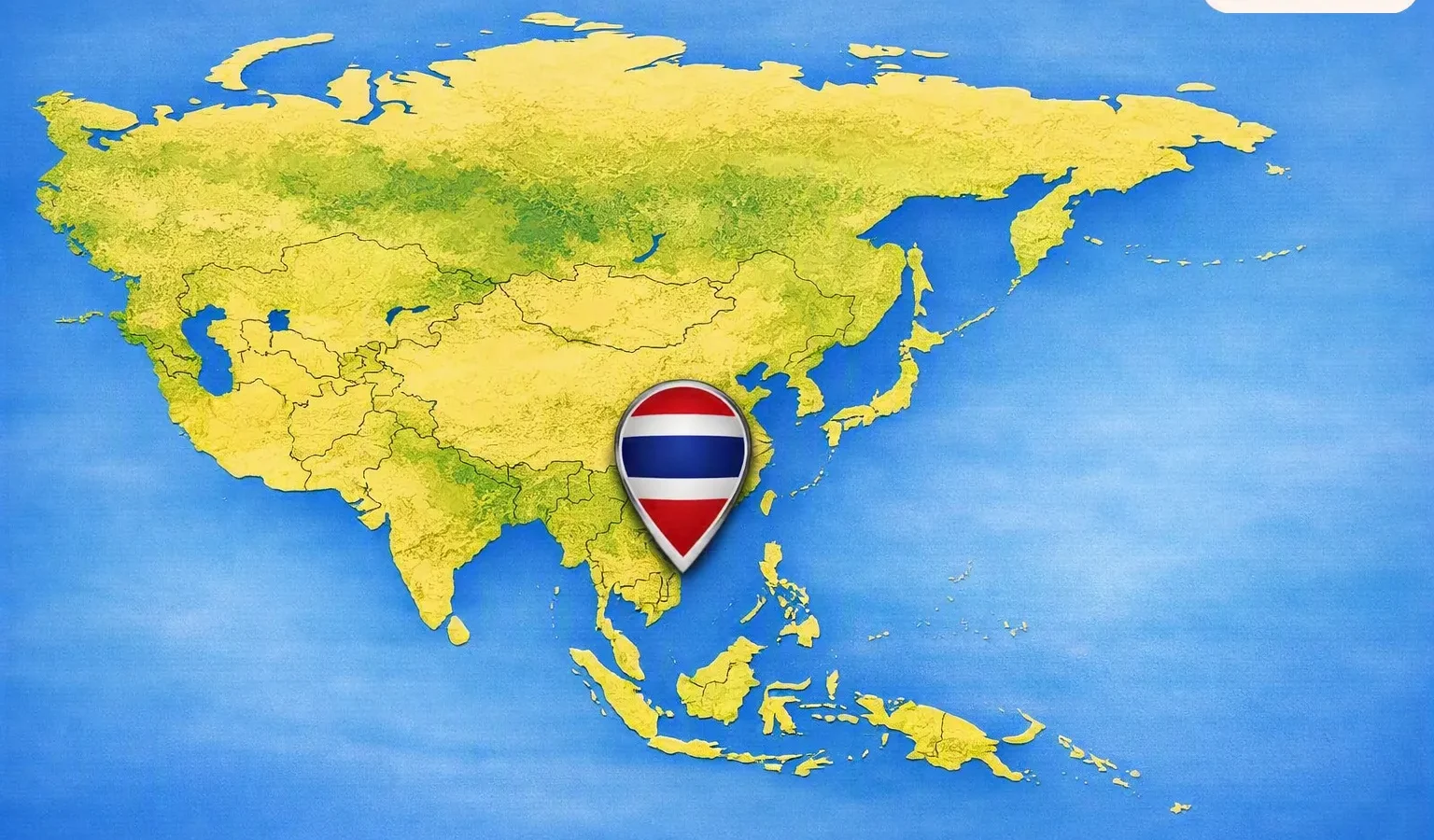
Thailand is the most established expat destination in Southeast Asia and the one where the gap between what is written online and what is actually in force is widest. Three things circulating as settled fact are not law at all, and one genuine risk is systematically under-weighted. This page starts there, because getting those wrong is expensive.
What Thailand offers is real: private healthcare among the best in Asia at a fraction of Western prices, a cost of living that lets a modest foreign income go a long way, a five-year visa built for remote workers, and a retirement route open at 50. What it asks in return is tolerance for discretionary bureaucracy, a road system that kills at five to ten times the rate of the countries most readers come from, and — in the north — three months a year of genuinely hazardous air.
Thailand at a glance
| Currency | Thai baht (THB). Around 32.7 to the US dollar in August 2026 |
| Official language | Thai. English proficiency ranks 116th globally on the EF index with a score of 402, against a global average of 488 |
| Visa-free entry | 60 days for US, UK, Canadian, Australian, NZ and EU passports, extendable once by 30 days for 1,900 THB. A reversion to 30 days was approved in May 2026 but is not yet in force |
| Main long-stay routes | DTV for remote workers (5 years, 180 days per entry); Non-O retirement at 50+; LTR through the Board of Investment (10 years); Thailand Privilege Card |
| Tax residency | 180 days or more in a calendar year. Foreign income is taxed on a remittance basis, not worldwide |
| Healthcare | Excellent private sector, among the world’s leading medical tourism destinations. No public entitlement for non-working foreigners — the 30-baht scheme is for Thai nationals only |
| Property | Foreigners cannot own land. Condominiums yes, subject to a 49 percent foreign quota per building |
| Road safety | 25.4 deaths per 100,000 — roughly five to ten times the US, UK, Canadian or Australian rate. This is the dominant real risk |
| Emergency numbers | 191 police, 1669 ambulance, 199 fire. 1155 Tourist Police is the English-speaking line and the one to actually use |
The three things most guides get wrong
Thailand does not tax worldwide income. This is the most aggressively misreported fact about the country. What changed on 1 January 2024 is narrower: under Departmental Order P.161/2566, a Thai tax resident who remits foreign income into Thailand is taxed on it in the year of remittance, rather than only when remitted in the year it was earned. Income earned before 1 January 2024 is grandfathered and stays outside the net. A draft amendment that would tax worldwide income regardless of remittance exists, was slated for 2025, and was not enacted. Headlines saying otherwise are describing a proposal.
Visa-free entry is still 60 days. On 19 May 2026 the Cabinet approved a tiered structure cutting most nationalities to 30 days, and a great many sites now report that as current. It has not been published in the Royal Gazette, and takes effect fifteen days after publication. Until then, 60 days stands. Check the Gazette rather than a blog before you book.
The company structure sold to you for buying land is a crime, and it is being prosecuted. Foreigners cannot own land in Thailand. The workaround — a Thai company with nominee shareholders holding no genuine interest — is an offense under the Foreign Business Act carrying up to three years’ imprisonment and forced sale of the land. Enforcement escalated sharply through 2025 and 2026: over 850 companies prosecuted, nearly 47,000 flagged, with operations concentrated in Phuket, Koh Samui and Koh Pha-ngan — precisely where agents describe the structure as standard practice. Detection now uses pattern-matching across shareholder registers and bank records.
Who Thailand suits
It works well for remote workers with foreign clients — the DTV was built for exactly this, and 500,000 THB in the bank is a far lower bar than most European equivalents. It works for retirees at 50-plus who are comfortable with an annual renewal cycle and a maintained bank balance. It works for anyone who wants private healthcare of a standard that would cost several times more at home. And it works for people whose budget is modest: a single person lives comfortably in Chiang Mai on 33,000 to 52,000 THB a month.
It suits people badly in three specific cases, all worth checking against your own situation before committing.
- If you are arriving in your late sixties or seventies without existing health cover. Most Thai insurers stop writing new policies between 65 and 75, pre-existing conditions are excluded permanently rather than after a waiting period, and the O-X visa’s Thai-insurer-only rule collides directly with those age limits. Moving at 55 is a materially different proposition from moving at 70.
- If you have asthma, COPD or cardiovascular disease and are drawn to Chiang Mai. The burning season runs January to April and peaks in March; on 4 March 2026 the city ranked third most polluted in the world. Many residents leave for two or three months a year.
- If you need certainty from administration. The same application produces different answers at different immigration offices, and sometimes at the same office on different days.
The risk nobody weights properly
Thailand’s road death rate is 25.4 per 100,000 people, against roughly 12 to 13 in the United States and 2 to 5 in the UK, Australia and Canada. Around 18,000 people die on Thai roads each year, and motorcycles account for the large majority.
There is a specific financial trap inside this that catches foreigners constantly. Riding a motorbike without the correct license class — a Thai motorcycle license or a motorcycle-endorsed International Driving Permit — typically voids both the vehicle insurance and your travel or health insurance claim. A car license does not cover a motorbike. Rental shops will hand over a scooter without checking, and the compulsory insurance every Thai vehicle carries provides only minimal cover. This is the most common route to a catastrophic uninsured medical bill in Thailand, and it is entirely avoidable.
Gender in Thailand: visible in daily life, absent from the law
Thailand has one of the most publicly visible transgender populations in the world, and that visibility is ordinary rather than confined to nightlife. Trans women work in shops, hospitals, universities, banks and government offices. The association with cabaret in Bangkok, Pattaya and Phuket reflects what is marketed to tourists, not the shape of the population.
People arriving from countries where trans people are less visible are often surprised by how unremarkable it is here. That is a fact about Thailand rather than about the people in question, and it is easier to absorb before you arrive than to work out on the street.
A note on words
Kathoey is the everyday Thai term, and “ladyboy” is how tourist marketing renders it in English — ubiquitous, and disliked by a great many of the people it describes. Sao praphet song is the courteous Thai form; in English, “trans woman” is the safe one. Asking someone whether they are trans is treated here as it would be anywhere else: a personal question you have not earned.
The law is where foreign residents get caught out, because it has moved in two directions at once. Thailand’s Marriage Equality Act took effect on 23 January 2025, 120 days after publication in the Royal Gazette on 24 September 2024, making Thailand the first country in Southeast Asia to recognize same-sex marriage. Marriage is now gender-neutral in law: “husband” and “wife” were replaced with “spouse” throughout the Civil and Commercial Code.
Legal gender recognition is a separate question, and Thailand still has none. A first Gender Recognition Bill was voted down in February 2024, and competing drafts — from the Ministry of Social Development and Human Security, the People’s Party and civil-society groups — have been pending since. Until one passes, a Thai national ID and passport carry the sex recorded at birth and the title that goes with it, whatever the holder’s life looks like.
The practical consequence is that documents govern. Banking, insurance, hospital admission, tenancy, employment paperwork and visa applications all run off the ID rather than off presentation, and a mismatch is a standing administrative fact rather than a one-off inconvenience. For a trans expat, Thai paperwork will follow whatever your home country’s documents say — which makes settling those before you move more consequential here than it first appears.
Where expats actually go
Three places cover most of the map, and they are genuinely different propositions rather than variations on a theme.
- Bangkok — the jobs, the hospitals, the international schools and the only real long-haul hub. Efficient within 400 meters of a rail station and difficult beyond it. Chronic heat rather than seasonal.
- Chiang Mai — cheaper, cooler, greener, with the deepest remote-work community in Asia. And three months a year of air that is a genuine health decision, not a nuisance.
- Phuket — beaches, an international airport, the best healthcare outside Bangkok, and the highest costs in the country. Also the epicentre of the nominee-structure prosecutions.
City hubs


National guides
These apply everywhere in Thailand. Where a rule differs locally, the city pages say so.
- Visas and Residency in Thailand — the DTV, retirement routes, LTR, Privilege Card, 90-day reporting and TM30
- Taxes in Thailand — the 180-day rule, what the remittance basis actually means, treaties, and what is proposal rather than law
- Healthcare in Thailand — private hospital costs, the public system’s limits for foreigners, insurance and the over-70 problem
- Cost of Living in Thailand — rents, the air conditioning bill, groceries and realistic budgets
- Property in Thailand — the land prohibition, the 49 percent condo quota, the FET form, leasehold, and why nominee companies are prosecuted
- Getting Around Thailand — road safety, licenses, Bangkok rail, intercity options and the long-haul flight problem
- Banking and Money in Thailand — which visas actually get you an account, PromptPay, and ATM fees
- Safety in Thailand — crime and scams, air quality, natural hazards, and the laws that catch foreigners out
- Schools and Education in Thailand — international school fees by tier and what sits between them and the public system
- Internet and Mobile in Thailand — fiber, mobile plans and what it costs
- Embassies and Consulates in Thailand — where to go and what each can actually do
Frequently asked questions
Does Thailand tax my worldwide income?
No. Thailand taxes foreign income only when it is remitted into the country, and only if you were a Thai tax resident in the year it was earned and it was earned on or after 1 January 2024. Income earned before that date is grandfathered. A draft law that would tax worldwide income regardless of remittance was planned for 2025 and was not enacted, but it is widely reported as though it were in force.
How long can I stay in Thailand without a visa?
60 days as of August 2026, for US, UK, Canadian, Australian, New Zealand and EU passport holders, extendable once by 30 days at an immigration office for 1,900 THB. A Cabinet decision on 19 May 2026 approved cutting this to 30 days for most nationalities, but it takes effect only fifteen days after Royal Gazette publication, which had not happened. Verify before you travel.
Can foreigners buy property in Thailand?
Condominiums yes, land no. Foreign nationals may own condo units outright, but the total foreign-owned floor area in any one building is capped at 49 percent, and the quota is checked at registration. Land ownership is prohibited under the Land Code. The Thai-company workaround with nominee shareholders is a criminal offense and enforcement escalated sharply in 2025 and 2026, with prosecutions concentrated in Phuket and the islands.
What is the DTV visa?
The Destination Thailand Visa, introduced in 2024: five years, multiple entry, 180 days per entry with one 180-day extension available in-country. It requires 500,000 THB in the bank and covers remote workers with foreign income, people doing Thai soft-power activities such as Muay Thai or cooking courses, medical treatment, and dependents. Two catches: consulates apply the financial test differently, with most requiring three months of seasoned balance, and Thai banks classify it as a tourist visa, so it does not reliably get you a bank account.
How much money do you need to retire in Thailand?
For the visa: 800,000 THB in a Thai bank account, or 65,000 THB a month in income, or a combination — with seasoning requirements before and after. For living: a single person lives comfortably in Chiang Mai on 33,000 to 52,000 THB a month and in Bangkok on 49,000 to 82,000. Health insurance is the variable that changes the arithmetic most, and it rises steeply with age.
Is Thailand safe?
Violent crime against foreigners is uncommon and the US State Department moved Thailand to Level 1, its lowest advisory tier, in July 2026. What foreigners actually encounter is commercial scams rather than predatory violence. The real danger is the roads: 25.4 deaths per 100,000 people, five to ten times the rate in most Western countries, with motorcycles accounting for the majority.
Can a transgender person change their gender on a Thai ID card?
No. Thailand has no legal gender recognition, so the sex recorded at birth and the title that accompanies it stay on the national ID and the passport. A Gender Recognition Bill has been pending in competing drafts since a first version was voted down in February 2024. This is separate from marriage law, which became gender-neutral when the Marriage Equality Act took effect on 23 January 2025.
Sources
- Thai Immigration Bureau and the Thai e-Visa system — visa categories and requirements
- Revenue Department Orders P.161/2566 and P.162/2566 — foreign income remittance; PwC Worldwide Tax Summaries for 2026 rates
- Board of Investment — the LTR visa and Royal Decree No. 743
- Tourism Authority of Thailand, July 2026 — status of the visa exemption change
- WHO Global Status Report on Road Safety — Thailand road death rate
- Department of Business Development, DSI and Department of Lands — nominee structure enforcement, 2025–2026
- IQAir and the Pollution Control Department — PM2.5 and burning season data
- EF Education First — English Proficiency Index
- Library of Congress, Global Legal Monitor — Thailand: Law Recognizing Same-Sex Marriage Takes Effect, March 2025
- Royal Gazette — Civil and Commercial Code amendment (Marriage Equality Act), published 24 September 2024, in force 23 January 2025
- UNDP Thailand — Transcending Discrimination: advocating for equal rights for transgender people in Thailand
What is it really like in Thailand?
We are asking residents, and publishing what they say. 0 of the 15 answers we need before we publish any numbers for this place. Four minutes, and the written answers are the part we read closely.
Would you write more than a survey answer? Tell us what you would write.
Follow Thailand
Rules change, prices move, and we reverify these pages. Get an email when something material changes here.

