

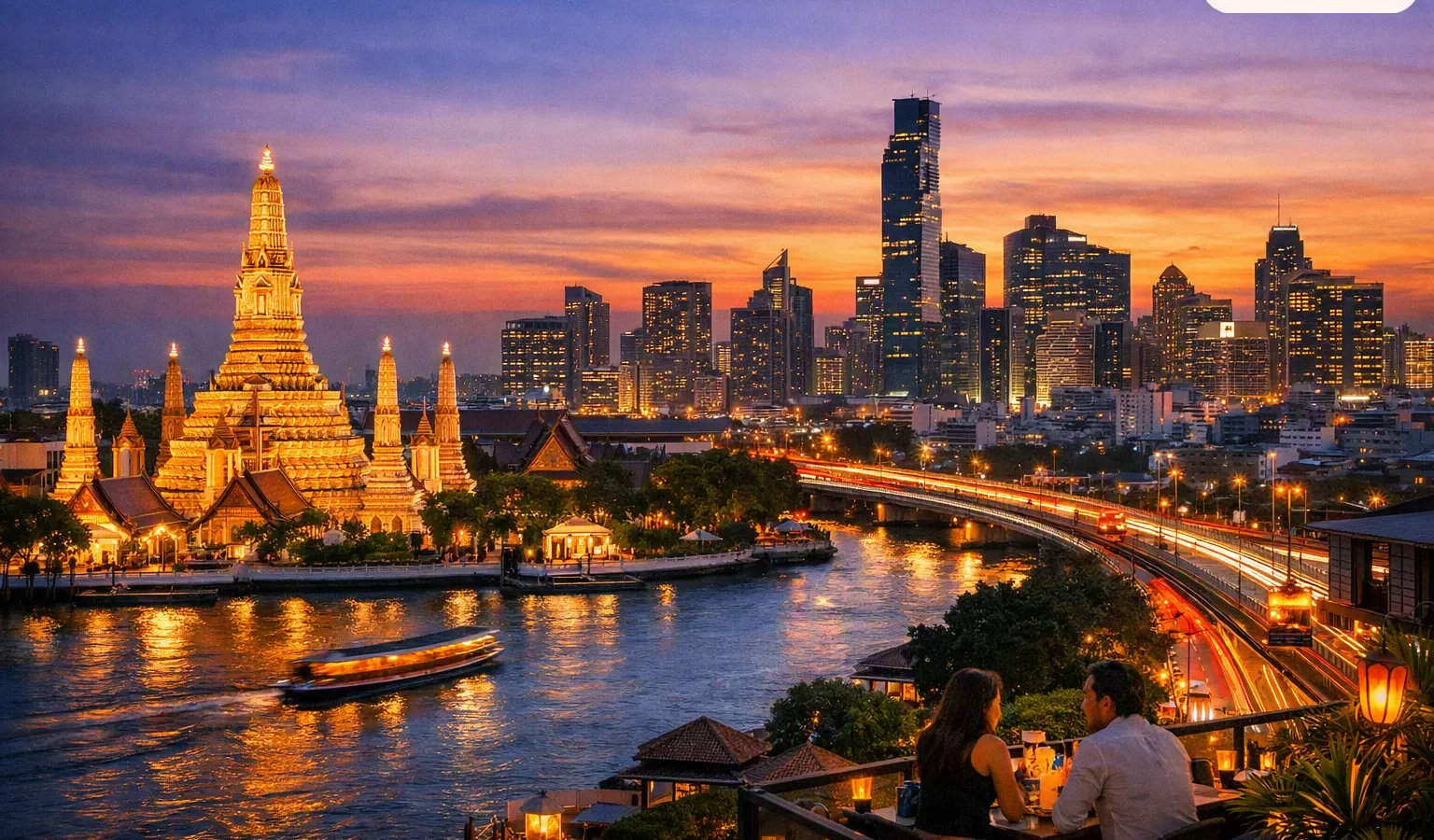
Bangkok is a low-rise sprawl of 1,569 square kilometers with a dense vertical spine grafted onto it along the rail lines, and the lived experience splits sharply along that spine. Within 400 meters of a station, life is efficient, air-conditioned and mall-mediated. Beyond it, the city becomes long sois, no pavements worth the name, and dependence on motorbike taxis.
Proximity to a rail station is the single highest-leverage decision a resident makes here, because rail journeys are predictable and road journeys are not. Everything else on this page is downstream of that.
Bangkok at a glance
| Rail network | Eight lines by 2026 — BTS Green, Gold, Pink and Yellow, MRT Blue and Purple, SRT Red, and the Airport Rail Link |
| Rent, 1-bed | 12,000–24,000 THB in the value belt; 18,000–35,000 central; 28,000–60,000 prime |
| Realistic monthly total | 27,000–38,500 THB frugal single; 45,500–75,500 comfortable single; 74,500–127,500 a couple |
| Heat | Average highs never drop below 32.3 C in any month and peak at 35.8 C in April |
| Air quality | PM2.5 season December to March. On 14 January 2026 the citywide average hit 58.1 µg/m³ against a 37.5 national standard |
| Traffic | 115 hours lost per driver per year; 10 km takes 31 minutes in the evening peak |
| Airport | Suvarnabhumi, 30 km east, under 30 minutes on the Airport Rail Link. Don Mueang for low-cost carriers |
| Healthcare | The deepest private hospital market in Southeast Asia. English at the premium tier is trivially easy |
Who Bangkok suits
It works for people on a foreign or corporate salary who want a genuinely large city — world-class food, the best medical care in the region, the deepest international school infrastructure in Southeast Asia, direct flights almost everywhere, and 24-hour convenience. It works for families, and for anyone whose work requires a real business center rather than a lifestyle destination. It works for people who are indifferent to walking and happy to move between air-conditioned interiors.
It works badly for anyone who wants to walk daily for pleasure — the pavements and the heat make that genuinely unpleasant for most of the year. For anyone sensitive to particulates, because the December to March season is severe. And for retirees on tight fixed incomes, who get materially more for their money in Chiang Mai or the provinces.
The heat is chronic, not seasonal
This is the fact most visitors misjudge because they came in November. Average daily highs never drop below 32.3 C in any month, and peak at 35.8 C in April. In April 2026 the Bangkok Metropolitan Administration recorded the heat index in its “Danger” band for 18 consecutive days, peaking at 51.9 C, and advised stopping outdoor activity between 11:00 and 15:00.
The year has a shape worth learning: December to March is the pollution season, March to May the extreme heat, May to October the rains with routine street flooding, and November to early December the short window that is genuinely pleasant. There is no season that is comfortable and clean and dry at once, except that one.
The walkability problem is real
Not a quibble — a structural constraint on how you will live. Pavements across most of the city are uneven and obstructed by parked motorbikes, vendor carts, utility poles and drainage grates, with sudden unramped drops. Signalised pedestrian crossings on major arteries are rare and drivers do not reliably yield at the ones that exist.
Then there is the geometry: Bangkok’s superblock layout means soi mouths are often 500 meters to a kilometer apart, so two points 200 meters apart as the crow flies can be a 1.5 km walk. Add 33 to 36 C and 65 to 78 percent humidity and daily walking becomes realistic only in short bursts between air-conditioned spaces.
Where to live
Sukhumvit is where most Western and Japanese arrivals land, and it is not one place — Asok, Phrom Phong, Thonglor, Ekkamai and On Nut are genuinely different in cost, noise and character. Sathorn and Silom are the financial and diplomatic district. Ari is the low-rise, tree-lined, more Thai option and the most walkable part of the city. Ratchathewi is the cheapest genuinely central address. Bang Na is the family suburb, chosen for school catchment. Full detail with 2026 rents and the trade-off on each.
An ordinary week
Work; a couple of gym or Muay Thai sessions; food, which is the city’s actual center of gravity — a street cart for breakfast, a shophouse or food court for lunch, a rotating list for dinner; a weekend market; and for the outdoors-inclined, a very early run in Lumphini or Benjakitti before the heat arrives.
The single best answer to “where do I go to not be in Bangkok for a day” is Bang Krachao, the Green Lung — a 16 square kilometer river-bounded peninsula reached by a four-baht ferry, with elevated cycle paths through mangrove. More, including the markets residents actually use.
The community, and its boundary
Worth being precise, because the word “expat” flattens something important. Thailand’s foreign population is overwhelmingly migrant labor — Myanmar, Cambodian and Lao — with Western expatriates numbering roughly 200,000 nationally. In Bangkok, Japanese nationals are the largest single non-labor foreign community, centered on the Phrom Phong and Thonglor corridor, followed by Chinese, Korean and Indian communities.
On making Thai friends: harder than the surface friendliness suggests. Thai social life is organized around family, workplace and school cohorts, which are difficult to enter laterally. The people who succeed are learning Thai, doing a shared activity with Thais — Muay Thai gyms, running clubs, badminton, climbing — or working somewhere Thai-majority. The expat and Thai social boundary in Sukhumvit is real and self-reinforcing; Ari, Ratchathewi and the Thonburi side are noticeably more mixed.
Guides to Bangkok
- Neighborhoods — the Sukhumvit corridor decoded, plus Sathorn, Ari, Ratchathewi, Riverside, Bang Na and the cheap-with-rail option
- Housing — lease terms, the electricity meter question that saves thousands, and buying
- Cost of Living — 2026 budgets by tier and the air conditioning arithmetic
- Healthcare — the hospital tiers, what things cost, and the over-testing problem
- Getting Around — eight rail lines, the traffic numbers, and the fare cap foreigners cannot use
- Things to Do — markets, green space, day trips and the places residents know
Frequently asked questions
How much do you need to live in Bangkok?
27,000 to 38,500 THB a month frugally as a single person, 45,500 to 75,500 comfortably, and 74,500 to 127,500 for a couple — roughly USD 825 to 3,900 depending on tier. Those include health insurance, which many published figures omit. Anything below about 28,000 THB means value-tier rent, no insurance and near-total reliance on Thai food.
Which Bangkok neighborhood should I live in?
The rule that matters more than the name: within 400 meters of a rail station. Beyond that, Asok for maximum convenience and noise, Phrom Phong for families and the Japanese community, Thonglor for the most expensive food-and-bar culture, On Nut and Phra Khanong for value, Ari for the most walkable and most Thai option, Ratchathewi for the cheapest genuinely central address, Bang Na for school catchment.
Is Bangkok’s air pollution bad?
Seasonally, yes. December to March brings temperature inversions and low wind; on 14 January 2026 the citywide average was 58.1 µg/m³ against a 37.5 national standard, and in January 2025 more than 350 schools closed. Notably the worst districts are Bang Rak, Pathum Wan and Sathorn — the central business and expat districts. The rainy season is genuinely clean, reading 4 µg/m³ in late August 2026.
Is Bangkok walkable?
No, and that is a structural constraint rather than a quibble. Pavements are obstructed and uneven, signalised crossings are rare, and the superblock street layout means two points 200 meters apart can be a 1.5 km walk. Combined with 33 to 36 C and high humidity, daily walking works only in short bursts between air-conditioned spaces. Ari is the most walkable district, relatively.
When is the best time of year in Bangkok?
November into early December — the short window when the rains have stopped, the extreme heat has not started, and the pollution season has not begun. December to March is the PM2.5 season, March to May the extreme heat, and May to October the rains with routine street flooding. If you are visiting to decide whether to move, come in April rather than November.
Sources
- Bangkok Metropolitan Administration — heat index records, April 2026, and PM2.5 district readings, January 2026
- TomTom Traffic Index 2025 — Bangkok congestion data
- IQAir World Air Quality Report 2025 and Air4Thai
- CBRE Thailand and Bangkok Post — condominium pricing, 2026
- BTS, MRT and SRT published fare tables, 2026
What is it really like in Bangkok?
We are asking residents, and publishing what they say. 0 of the 15 answers we need before we publish any numbers for this place. Four minutes, and the written answers are the part we read closely.
Would you write more than a survey answer? Tell us what you would write.
Follow Bangkok
Rules change, prices move, and we reverify these pages. Get an email when something material changes here.

