

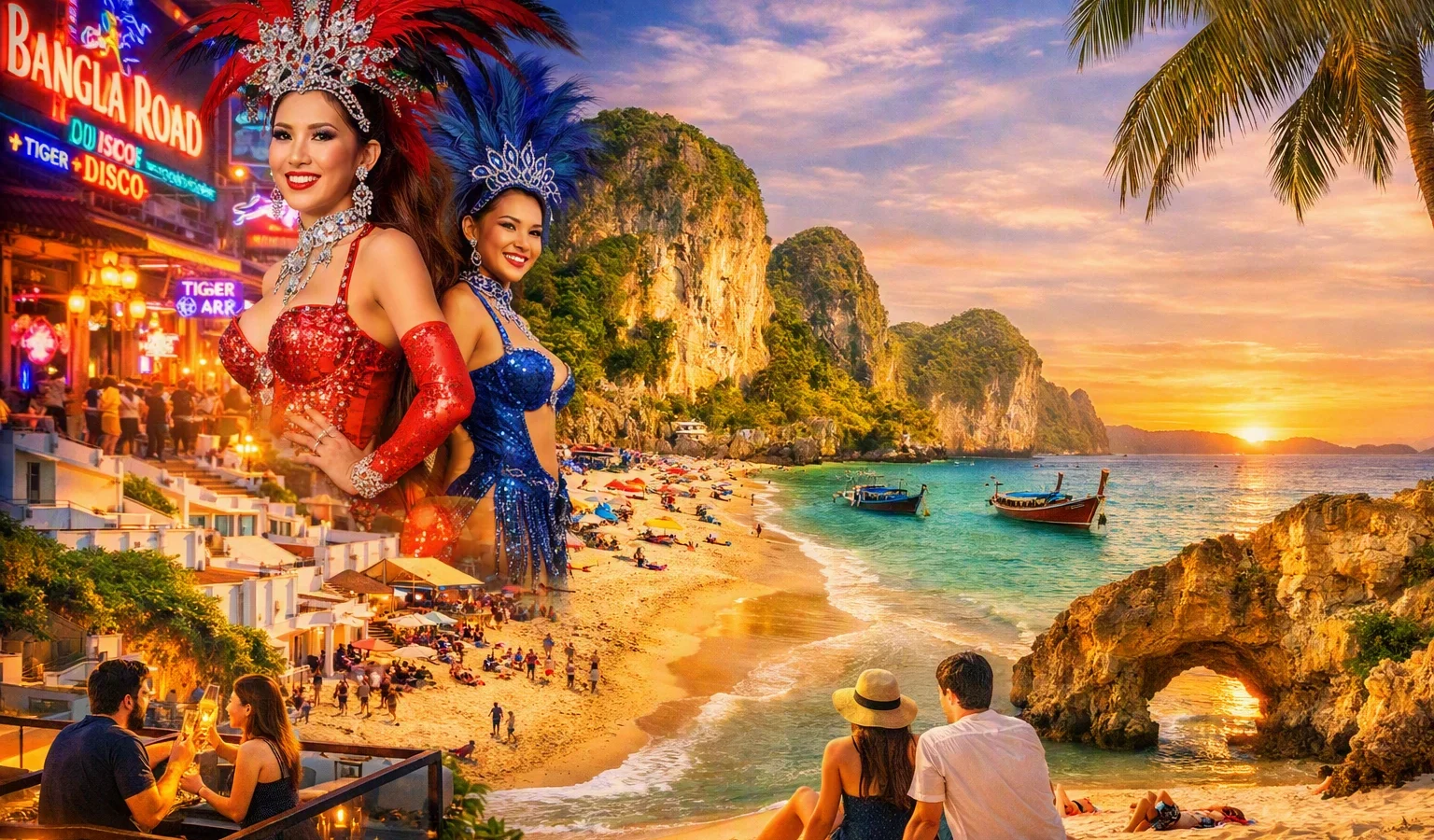
Phuket is not one place. The west-coast beach towns, the inland belt, the southern resident enclaves and Phuket Town are four different islands sharing a name, a 543 km² landmass and one tourism economy — and which of them you pick decides almost everything about what living here costs and what it feels like.
Thailand’s only island province runs roughly 50 kilometers north to south and is joined to the mainland by a single bridge. It is hot in every month of the year — the coolest average low in any month is 22.7°C — and it has the cleanest air of any major Thai destination, the best international schools outside Bangkok, and the worst road-safety record of the three places we cover. All of that is true at the same time.
Phuket at a glance
| Comfortable single, per month | 51,500–88,000 THB ($1,575–$2,690) |
| Comfortable couple, per month | 85,000–152,000 THB ($2,595–$4,645) |
| 1-bed, beach areas (12-month lease) | 14,000–28,000 THB ($430–$855) |
| 1-bed, Phuket Town or Kathu | 6,000–18,000 THB ($185–$550) |
| Airport | Phuket International (HKT), 45–75 minutes from the southern residential areas |
| Direct flights | Europe and the Gulf, heavily seasonal. None to North America. |
| Air quality | 11.4 µg/m³ annual average — the only Thai city IQAir has rated “Good” |
| Public transport | Four songthaew routes, all radiating from Phuket Town. A vehicle is effectively required. |
| Hottest month | March, 34.3°C average high |
| Wettest month | September, 325 mm across 19 rain days |
| Foreign residents (province) | ~100,000 by secondary estimate, blending migrant labor with the residential community. No reliable official count exists. |
| Data reviewed | August 2026 |
Who Phuket suits
People who actually use the sea — swimmers, divers, sailors, freedivers, kitesurfers — get more out of Phuket than anyone else. So do families on expatriate packages, who find the strongest international schools in Thailand outside Bangkok, plus space and a beach. Remote workers with real income who want a villa and a pool rather than a condominium do well. So do retirees with money: Phuket is a comfortable retirement if the budget stretches and an uncomfortable one if it does not.
It suits a shorter list badly. Budget retirees on a thin fixed income will find Phuket meaningfully more expensive than Chiang Mai and, in the northwest, more expensive than Bangkok. Anyone who wants to walk places, or use public transport, will be defeated by an island with no sidewalks on most roads and no beach-to-beach bus routes. Non-riders pay for it daily in Grab fares. People who dislike being outnumbered by tourists should avoid Patong, Kata and Karon entirely. And anyone who needs cultural or intellectual depth should know that the island’s offer is beaches, restaurants, boats and gyms — with Phuket Town the one genuine exception.
The roads and the sea, without softening
On the measurable indicators, Phuket is the most physically dangerous of the three Thai destinations we cover, and it is not close. During national road-safety monitoring periods the island has topped Thailand’s list for number of crashes outright. The dominant mode is motorcycle and the dominant victim is an inexperienced rider on an unfamiliar wet road. Helmet compliance is poor. Most roads have no sidewalk, so pedestrians share the carriageway with scooters.
The financial edge of this is the part people miss: most travel insurance and many health policies exclude motorcycle accident claims where the rider held no valid motorcycle license or IDP endorsement — which describes the majority of foreign riders on the island. If you intend to ride, get the endorsement before you arrive and check your policy wording rather than the marketing page.
The sea is the second number. Phuket records 30–50 drowning deaths a year, more of them during the May–October monsoon, when the west-coast beaches — Patong, Karon, Kata, Kamala, Surin, Bang Tao, Nai Harn, Nai Thon, Freedom — develop powerful rip currents and are frequently red-flagged. The flag system runs green, yellow, red, black; most drownings involve people swimming past a red flag or at an unguarded beach. Lifeguards cover five beaches — Patong, Karon, Kata, Bang Tao and Surin — and only in daylight. During the monsoon the sheltered east-coast water at Ao Yon and Panwa, and the offshore islands, are the safer options.
There is no transport fix coming. The 41.7 km Phuket light rail from the airport to Ha Yeak Chalong remains at feasibility-study stage: approvals are scheduled for July 2026 to February 2027, bidding through August 2028, construction start September 2028 and a notional service launch in December 2031. Treat the tram as vapor for planning purposes. The realistic near-term work is road widening on Highways 402 and 4027 and five underpasses at Thalang — which will themselves cause disruption before they relieve any.
Where to live
Rents below are 2026 figures on a 12-month lease, which is close to the low-season baseline. Month-to-month rates in high season run 40–100% higher, and mid-December to mid-January and Chinese New Year can be triple with minimum stays enforced. Standard terms across the island: two months’ deposit plus one month in advance, furnished as standard, landlord pays the agency commission, 30–60 days’ notice. Foreigners may lease on any visa.
| Area | 1-bed, 12-month lease | Who lives there | The trade-off |
|---|---|---|---|
| Cherng Talay, Bang Tao, Laguna | 18,000–45,000 THB | Families, corporate expats, the school population | The most expensive part of the island, 1.5–2.5× the average. Heavy construction, real traffic, and a resort-compound quality some find placeless. |
| Surin, Kamala | Kamala 15,000–25,000; Surin 20,000+ | Couples and solo remote workers wanting quiet with a view | Limited amenities, few schools, exposed west-coast beaches with monsoon closures. |
| Patong | 14,000–28,000 THB | People working in tourism, nightlife and diving | Noisy at all hours, bad traffic on the hill road, and everything from a beer to a haircut is priced above the rest of the island. |
| Kata, Karon | 15,000–28,000 THB | Long-stay Northern European and Russian couples and retirees | Extremely seasonal — Kata in June is close to shut — and both beaches are red-flagged for much of the monsoon. |
| Rawai, Nai Harn | 12,000–25,000 THB | The heart of the long-term resident community; retirees, remote workers, the Muay Thai scene | No nightlife, Rawai beach itself is not swimmable, and it is 45–60 minutes from the airport. |
| Chalong, Wichit | 11,000–19,000 THB | Practical residents who want to be central by island geography | No beach, no charm, and the Chalong circle at rush hour. |
| Phuket Town | 6,000–18,000 THB | Budget-conscious and culture-oriented residents, younger remote workers, Thais | No beach — 30–45 minutes to the west coast — and no sea breeze. The cheapest part of the island by a distance. |
| Kathu | 8,000–15,000 THB | Value-seekers with a scooter; golf and school families | Unremarkable, but 15 minutes to Patong and 15 to Phuket Town. |
Two patterns are worth naming. Rawai and Nai Harn offer the best value-to-quality ratio on the island — near-average rent, the best swimming beach, and the densest concentration of people who actually live here rather than visit. And Phuket Town is the only part of the island where daily life is priced for Thais rather than tourists, and the only part where a person could plausibly live without a vehicle.
An ordinary week
Work; the sea most days if you live on the coast; a gym or a Muay Thai session; a market run; dinner at one of the same six or eight places; and, for the large boating and diving community, a weekend on the water. Naka Weekend Market in Phuket Town is where locals actually shop. The Sunday Walking Street on Thalang Road closes the Sino-Portuguese shophouses to traffic. Rawai Seafood Market lets you buy from the boats and carry it across the road to be cooked for a fee. Boat Avenue’s Friday market is the northwest’s weekly social event.
Phuket Old Town deserves its own line — Thalang, Dibuk, Krabi and Phang Nga Roads and Soi Romanee, Peranakan shophouses, the Thai Hua Museum, and the best food on the island: mee hokkien, moo hong, o-tao, dim sum. Residents who dismiss Phuket as a resort have usually not spent time here.
Getting off the island is easy and underused. Bang Rong Pier puts you on Koh Yao Noi in 30 minutes for around 150 THB. Phang Nga Bay is an hour to the pier and then by boat. Khao Lak is 90 minutes north, Krabi and Railay three hours by road or two by ferry.
The two Phukets: high season and low
Seasonality here is stronger than at any other destination we cover. November to April is dry, calm and full: restaurants busy, roads gridlocked, 60,000–80,000 visitors on the island daily at peak, short-term rents doubled. May to October is the southwest monsoon: rough west-coast seas, many businesses shut, hotel and restaurant staff laid off, rents down 30–50%, and a much quieter, cheaper, more liveable island. The Similan and Surin Islands — the island’s best diving — close by law from 15 May to 15 October.
Long-term residents overwhelmingly prefer low season. The practical consequence for a newcomer is simple: sign a 12-month lease and you lock in something close to the low-season baseline. Rent month to month in December and you pay roughly double for the same apartment.
Guides to Phuket
- Neighborhoods — the four Phukets, area by area, with rents and who actually lives in each
- Housing — villas versus condominiums, the seasonal lease trap, and what foreign ownership really allows
- Cost of living — 2026 budgets for a single, a couple and a family, including the villa electricity bill nobody budgets for
- Healthcare — the four private hospitals, the public alternative, and what gets referred to Bangkok
- Transportation — songthaew routes, the tuk-tuk problem, riding safely, and the airport run
- Things to do — diving, sailing, Old Town, day trips, and the festival calendar
Frequently asked questions
Do I really need a motorbike or a car?
Effectively, yes. Phuket has no rail, four songthaew routes that all run through Phuket Town, no timetable, service that thins sharply after 18:00, and almost no direct beach-to-beach connections — getting from Kata to Bang Tao by songthaew means going into town and back out. Grab and Bolt work and cost 150–400 THB per cross-island trip. Tuk-tuks charge 200–600 THB for journeys that would be 60–100 THB in Bangkok, and long-term residents essentially never use them. Budget 2,500–4,500 THB a month with a scooter, 8,000–15,000 THB running a car. The exception is Phuket Town, where daily life is walkable.
How much more expensive is Phuket than Chiang Mai?
Substantially, and the gap widens with a Western diet. A budget single living inland or in Phuket Town can run 26,500–44,000 THB a month; a comfortable single 51,500–88,000; a comfortable couple 85,000–152,000. Rent is the main driver, but the tourist economy sets prices for residents too: a Western restaurant main is 300–600 THB in Bang Tao or Patong, and a beer that costs 60 THB in Phuket Town costs 150–250 THB in a beach venue. Eating mostly Thai food, budget 8,000–12,000 THB a month; eating mostly Western, 20,000 THB and up. That gap is wider in Phuket than anywhere else in Thailand.
Can a foreigner buy a villa in Phuket?
Not the land under it. Foreigners may own condominiums freehold within a building’s 49% foreign quota. Villas are typically held on 30-year renewable leases or through Thai company structures — and the company route is the one to be careful about. Nominee shareholding to hold land is a prosecuted crime, with more than 850 companies prosecuted nationally and enforcement concentrated in Phuket, Samui and Pha-ngan. Anyone being shown a villa “with company ownership included” should take independent Thai legal advice before signing anything.
Is Phuket’s air really clean?
Yes, by Thai standards, and by a wide margin. IQAir’s most recent published annual figure for Phuket is 11.4 µg/m³ — the only Thai city to reach the “Good” annual category that year, against Chiang Mai’s 32.3 and a national average of 17.8. The worst month, March, averages 17.6 µg/m³, which would be an exceptionally clean day in Chiang Mai’s burning season. There is no burning-season equivalent here. The caveats: transboundary haze from Sumatran fires can reach the Andaman coast in a bad year, usually August to October; construction dust is a local problem in the fast-developing northwest; and single-hour readings do spike. Residents do not own purifiers or wear masks, and outdoor exercise is not seasonally canceled.
How good is the healthcare?
Good for most things, not for everything. Bangkok Hospital Phuket is JCI-accredited, has around 400 beds and full-time interpreters, and is the default for insured foreign residents; Siriroj is strong in cardiology and chronic disease management. Vachira Phuket is the main public hospital and is 30–95% cheaper depending on the service, but English is inconsistent outside a handful of foreign-trained specialists and there is no direct billing with international insurers. Complex oncology, cardiac surgery and neurosurgery are generally referred to Bangkok, pediatric subspecialty care is thin, and mental health services in English are minimal.
Sources
- IQAir — Phuket annual and monthly PM2.5 averages, and district monitor readings, August 2026.
- Phuket rental market surveys and agency listings, 2026, cross-checked across areas for 12-month lease rates.
- CBRE and developer market reports — Phuket condominium and villa launch volumes and price per square meter, 2025–2026.
- Airports of Thailand — Phuket International passenger figures, 2024 and H1 2025.
- Mass Rapid Transit Authority of Thailand — Phuket light rail feasibility timetable, 2026.
- Thai road-safety monitoring reports and Phuket provincial crash data.
- Phuket hospital published consultation tariffs, 2026. Verify current rates directly.
- Thai Meteorological Department and long-run climate averages for Phuket.
- Department of National Parks — Similan and Surin Islands annual closure dates.
What is it really like in Phuket?
We are asking residents, and publishing what they say. 0 of the 15 answers we need before we publish any numbers for this place. Four minutes, and the written answers are the part we read closely.
Would you write more than a survey answer? Tell us what you would write.
Follow Phuket
Rules change, prices move, and we reverify these pages. Get an email when something material changes here.

