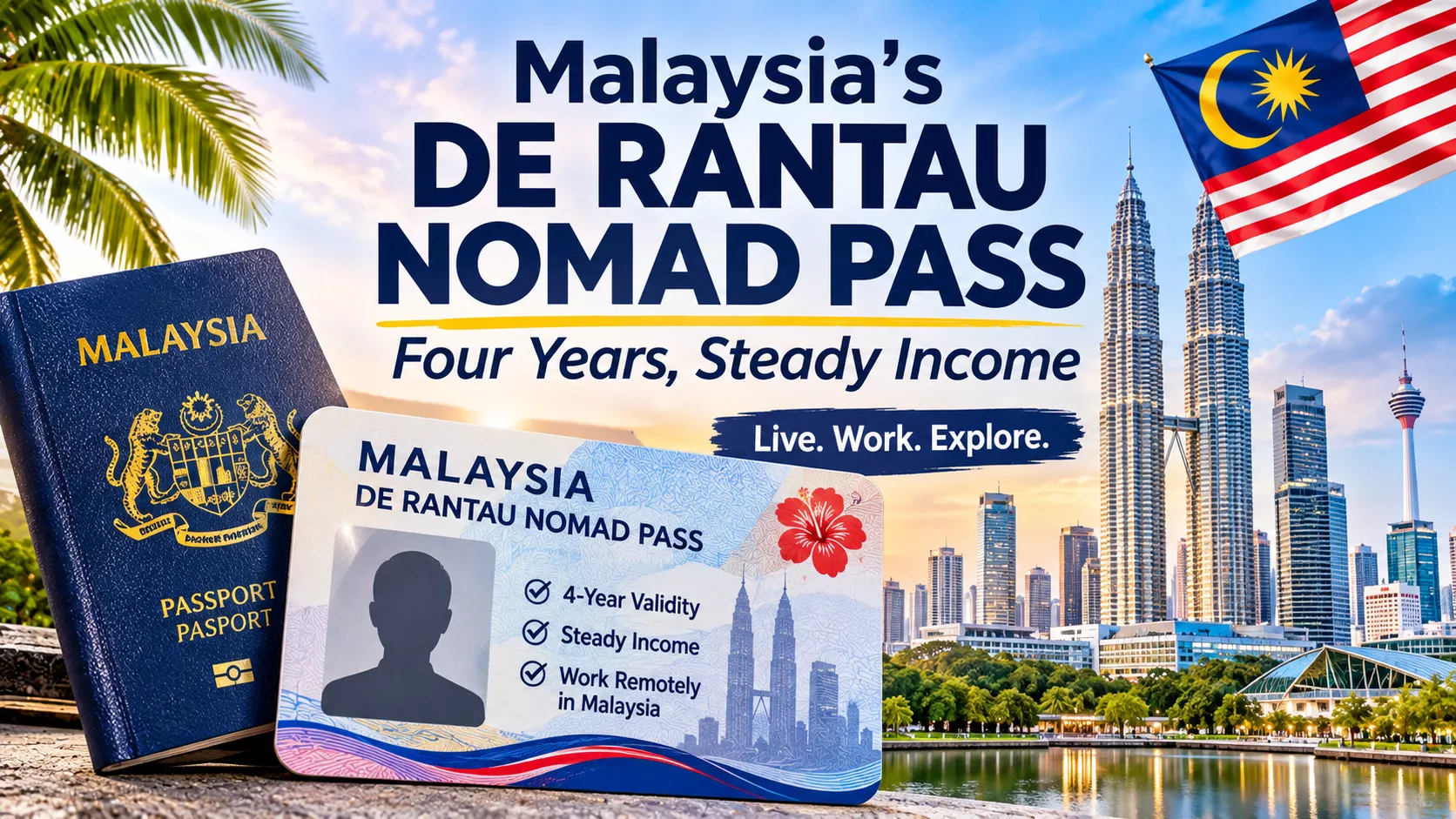
The Malaysia DE Rantau Nomad Pass becomes a four-year pass on December 1, 2026, and the income floor for tech applicants rises by half. New applications are paused in the meantime. If you already hold the pass, the renewal rules you were planning around have changed.
The source is MDEC’s own documentation rather than a press release. The Enhanced DE Rantau Nomad Pass Framework FAQ, published alongside the program FAQ on MDEC’s DE Rantau page, says the framework “shall take effect from 1 December 2026” and applies to renewal applications submitted on or after that date.
The Malaysia DE Rantau Nomad Pass now runs four years
The headline is a maximum stay of up to four years: an initial pass plus up to three renewals of up to 12 months each. That is 48 months, up from the 24 months most current holders have been working with.
Renewal is not automatic. MDEC says so twice in the enhanced framework FAQ, and it adds a requirement that did not exist before — a Renewal Eligibility Report is mandatory for the second renewal.
One point is genuinely unclear in MDEC’s own paperwork. The general DE Rantau Pass FAQ, version 11.0 dated November 1, 2026, describes the professional visit pass as “valid for an initial stay of 3 to 12 months, with up to three (3) 12-month renewals, for a maximum total stay of 48 months subject to continued eligibility and approval.” The enhanced framework FAQ describes the initial pass as 12 months. Both are MDEC documents, and neither text says which governs the length of the initial grant. Ask before you plan around a full first year.
Tech applicants now need USD 36,000
The minimum annual income threshold for tech talent rises from USD 24,000 to USD 36,000 — a 50 percent increase. Non-tech applicants stay at USD 60,000. The enhanced framework FAQ says the new threshold applies to both new and renewal applications from December 1, 2026, which is the part people miss: a renewal is assessed against the higher figure, not the one you qualified under.
New applications are paused
MDEC states that new applications are “temporarily unavailable during the transition period.” It gives no start or end date for that pause.
Envoy Global’s November 17 alert says applications are closed from November 1 through November 30, 2026. That window does not appear in MDEC’s text, so treat it as a secondary report and check the portal before you assume a reopening date.
If you already hold the pass
The transition rules are specific, and they turn on dates:
- You may remain in Malaysia until your approved expiry date.
- First renewals stay open during the transition, but only where the initial 12-month pass expires on or before January 31, 2027.
- Second and third renewals open from December 1, 2026. If you have already used the old 24-month maximum, your only route is a renewal on or after that date under the new rules.
- A Renewal Eligibility Report is mandatory for the second renewal.
- Renewal fees are unchanged, and you can file a renewal from outside Malaysia.
The parts that have not changed
From FAQ version 11.0: the processing fee is RM1,080 for the principal applicant and RM540 per dependent, both including 8 percent SST and both non-refundable. The immigration pass fee is RM90 per three months or RM360 per year, paid at endorsement. Where MDEC acts as sponsor, a personal bond of RM200 to RM2,000 applies depending on nationality, refunded at expiry.
Dependants are limited to a spouse, children under 18 (no age limit for a child with special needs, and the principal holder’s parents. The spouse cannot work on a dependent pass. The principal applicant must be over 18, and the pass is open to all nationalities except Israeli citizens.
It is still not a path to anything permanent. MDEC states plainly that the pass leads to neither permanent residence nor citizenship, which is worth remembering when a four-year ceiling starts to look like settling down.
What to do about it
If your initial pass expires on or before January 31, 2027 and you have not used your first renewal, file during the transition window rather than waiting for December. That first-renewal route is defined by the expiry date, not by when you get around to it.
If you are in your second year and had assumed the pass simply ended at 24 months, you now have somewhere to go — but you will be measured against the higher income threshold and the eligibility report, so get your income documentation in order before December.
If you are a new applicant, wait for the portal to reopen and make sure your documented annual income clears USD 36,000 for a tech role or USD 60,000 otherwise. If a four-year ceiling doesn’t suit you, the nearest alternative is worth comparing on paper first: our guide to visas and residency in Thailand covers the other main long-stay base in the region.
Long-stay rules are moving in several places at once. The UK has confirmed a 10-year default wait for settlement, France has cut residence permit decisions to 90 days, and Sweden starts issuing a new ID card for foreign residents on December 1.