

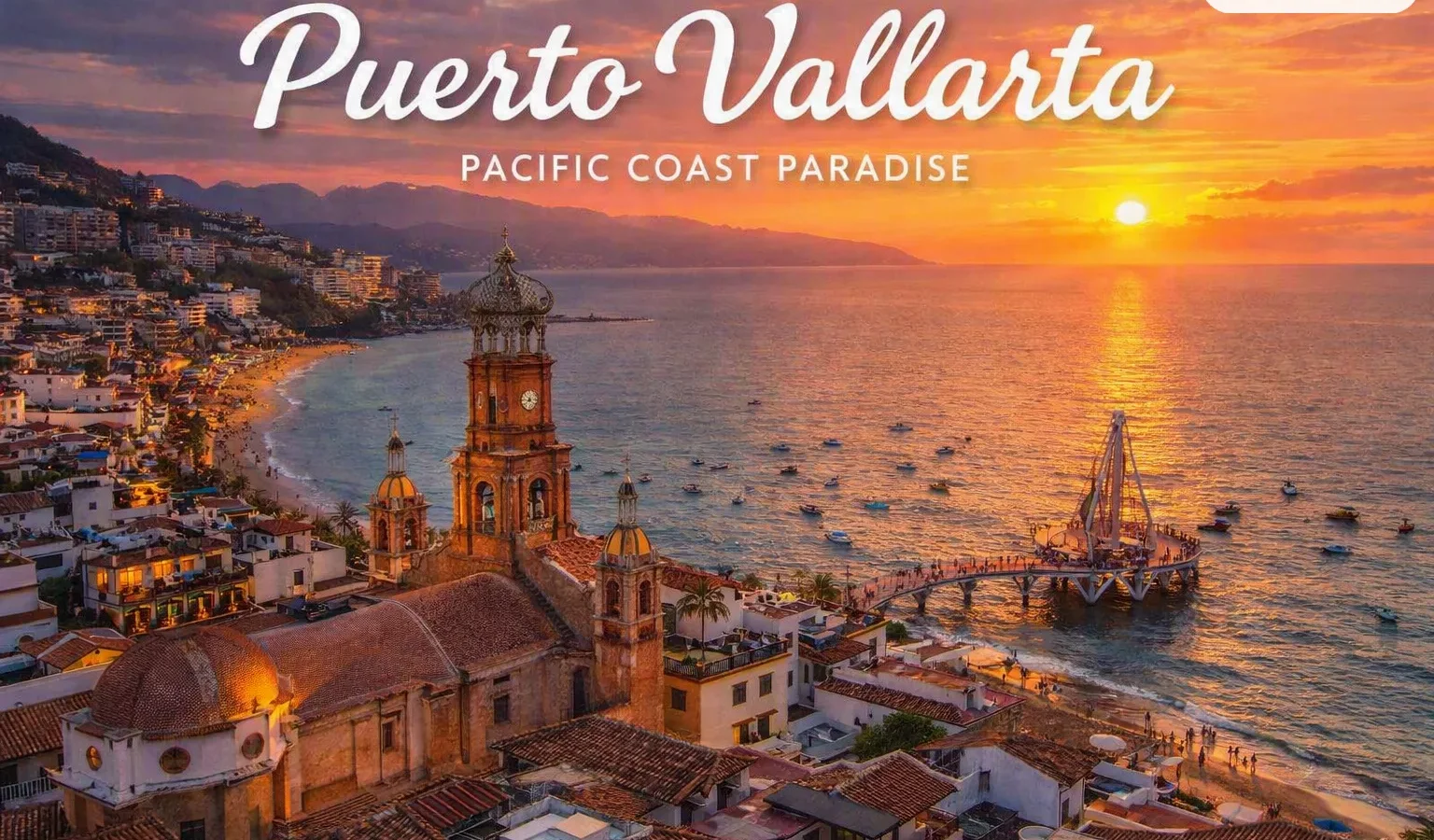
Puerto Vallarta is the most established foreign-resident city on Mexico’s Pacific coast, and the one with the deepest Canadian connections anywhere in the country. It is also a city with two economies running through the same streets — a winter one priced for visitors and a summer one priced for the people who live here — and understanding which one you are buying into is most of what you need to know before moving.
Puerto Vallarta at a glance
| State | Jalisco — but the bay’s northern half is in Nayarit |
| Population | 291,839 in the municipality; 479,471 across the bay metro area |
| Foreign-born residents | 9,809 across the metro area, about 2% — and far more in winter |
| Furnished two-bed | Roughly 28,000 to 55,000 pesos a month, seasonally |
| Bus fare | 11 pesos |
| Safety | 32% of residents feel unsafe, against 79.2% in Guadalajara |
| Airport | Around 478 weekly departures to 54 destinations, 16 of them Canadian |
| Rainy season | June to October; Pacific hurricane season 15 May to 30 November |
Is Puerto Vallarta right for you?
Vallarta’s appeal is not complicated. It is a genuinely walkable old town on a beautiful bay, with a foreign community established enough that everything from a dentist to a book club already exists in English, and an airport that flies non-stop to more Canadian cities than any other beach destination in Mexico — Toronto, Vancouver, Calgary, Montreal, Edmonton, Winnipeg, Ottawa, Quebec City, Regina and Saskatoon.
It is also Latin America’s most established LGBTQ+ destination, and that is not marketing language. The Zona Romántica holds an official municipal designation as a friendly LGBTQ+ district — the only government-recognized one in Mexico — which comes with a formal requirement that the city consult residents of the district on infrastructure work, explicitly to protect its character. Vallarta Pride drew around 240,000 visitors in May 2026 and roughly 40% of local tourism revenue is attributed to LGBTQ+ visitors. For a resident, what that translates to is a city where the question does not arise.
The honest counterweights are three.
Seasonality is severe. The same one-bedroom can go for 15,000 pesos in low season and 30,000 to 35,000 in winter, and in January and February finding a long-term rental at any price is genuinely hard. Landlords who can capture nightly winter rates have every incentive to keep units out of the annual market. Arrive in October, not January.
It is not a cheap city. Jalisco is among the more expensive states, and Vallarta prices to foreign incomes in the areas foreigners want. The value is real in Versalles and Pitillal; it is thin in the Zona Romántica and Marina Vallarta.
Security perception is good but not static. Only 32% of residents report feeling unsafe — very low by Mexican standards and a fraction of Guadalajara’s 79.2%. But a violent incident in March 2026 cut the peak season short, with hotel occupancy falling from 81.2% to 59.1% year on year in a single month, and first-half occupancy for 2026 came in at 69.4% against 75.4% the year before. The city recovered, and the honest summary is that Vallarta is a safe place to live in a state that periodically has a bad week.
The two-state problem
Worth understanding before you sign anything. Puerto Vallarta is in Jalisco. The northern half of the bay — Nuevo Vallarta, Bucerías, Sayulita, Punta de Mita — is in Nayarit, a different state with its own taxes, its own vehicle and licensing authority and its own rules, even though it is a twenty-minute drive and part of the same metropolitan area.
People routinely rent in one state and register a car or a license in the other and are surprised when the paperwork does not match. Decide which side of the Río Ameca you actually live on.
Weather and storms
Around 27 °C in winter and 32 °C in summer, with roughly 360 sunny days a year and a rainy season from June to October that arrives as afternoon and evening thunderstorms rather than all-day drizzle.
The Pacific hurricane season runs 15 May to 30 November, and the 2026 forecast was for an above-average season with Jalisco flagged as a focus state. The bay gives some protection from a direct eye landfall, but the exposure is real and history shows it comes in two forms: Kenna in 2002 made landfall in Nayarit yet destroyed much of Vallarta’s malecón by storm surge, and Nora in 2021 brought rain rather than wind — the Río Cuale overflowed and took out the city’s oldest bridge. Flooding and surge, more than wind, are what to plan for.
Living in Puerto Vallarta
- Housing — the seasonal rental squeeze, the coastal bank trust, and what buying costs
- Neighborhoods — Zona Romántica to Versalles, and which ones need a car
- Cost of living — a monthly budget, utilities, and what the seasons do to it
- Healthcare — the private hospitals, what happened to San Javier, and evacuation to Guadalajara
- Getting around — buses, the airport taxi problem, water taxis and Jalisco licenses
- Things to do — the malecón, the Marietas permit system, whales, and the beaches you can only reach by boat
Frequently asked questions
How many foreigners live in Puerto Vallarta?
The census counts 9,809 foreign-born residents across the Puerto Vallarta and Bahía de Banderas metro area, about 2% of the population, of whom 6,080 were born in the United States. That figure counts people present on census night, so it structurally excludes the winter snowbird population — the real seasonal foreign presence is considerably higher, though no reliable count of it exists.
Is Puerto Vallarta safe?
By Mexican standards, yes — 32% of residents report feeling unsafe, against 79.2% in Guadalajara and a national average near 60%. The qualification is that Jalisco has periodic episodes of organized-crime violence: an incident in March 2026 cut the tourist season short, with hotel occupancy dropping from 81.2% to 59.1% in a month. Day-to-day life in the city is not the issue; the state’s wider security situation occasionally is.
Why is Puerto Vallarta popular with LGBTQ+ residents?
The Zona Romántica carries an official municipal designation as a friendly LGBTQ+ district, the only government-recognized one in Mexico, which obliges the city to consult district residents on infrastructure work. Vallarta Pride drew around 240,000 visitors in 2026 and about 40% of local tourism revenue is attributed to LGBTQ+ visitors. Community infrastructure — a community center, established organizations — exists year round rather than only during Pride.
When is the best time to move to Puerto Vallarta?
Arrive in the low season, roughly May to October, when long-term rentals are available and priced at half what they command in winter. January and February are the hardest months to find anything at all, because units that can earn nightly winter rates are withheld from the annual market. The trade is that you arrive into heat, humidity and the rainy season.
Sources
- INEGI census and IIEG Jalisco for population and foreign-born residents; INEGI ENSU for perceived insecurity.
- DATATUR hotel occupancy via local reporting, first half of 2026.
- Municipal designation of the Zona Romántica LGBTQ+ district; Vallarta Pride economic reporting, May 2026.
- CONAGUA 2026 Pacific hurricane season forecast; local reporting on Kenna, Nora and Lidia.
- Page checked August 2026.
What is it really like in Puerto Vallarta?
We are asking residents, and publishing what they say. 0 of the 15 answers we need before we publish any numbers for this place. Four minutes, and the written answers are the part we read closely.
Would you write more than a survey answer? Tell us what you would write.
Follow Puerto Vallarta
Rules change, prices move, and we reverify these pages. Get an email when something material changes here.

